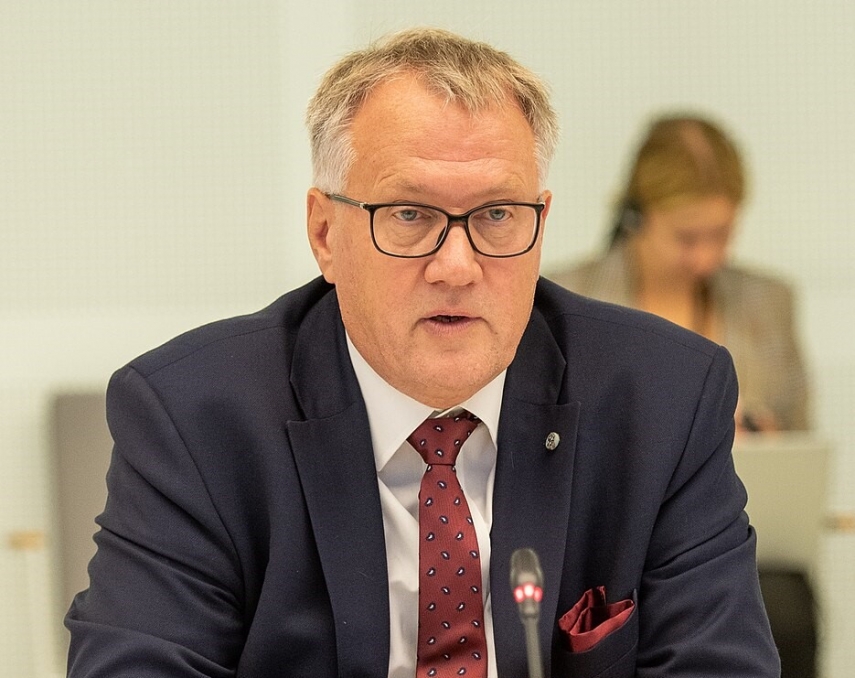
RIGA - Strengthening defense capabilities will be the main challenge for the European Union (EU) in 2026, MEP Robert Zile (National Alliance), Vice-President of the European Parliament (EP), told LETA.
Europe's role in global security is closely linked to its military capabilities, he said, but developments so far show that Europe is not perceived as a serious military power.
Zile draws attention to the fact that Europe is not fully involved in the peace talks launched by the US on the war in Ukraine, which, in his view, demonstrates the need for substantial investment in the military sector. At the same time, the EP Vice-President points out that although many countries are aware of this need, there is still much to be done in the area of defense.
Zile considers the negotiations on the new EU multiannual budget for 2028-2034 to be an important issue for Latvia in 2026. He points out that the total funding is unlikely to be higher than in the previous period, but the conditions for using the funds will change. Each member state is expected to have a set amount that can be used for both regional development and agriculture, which will create difficult political choices at national level.
Under such a model, the richer countries will be able to afford to pay more to farmers, while less wealthy countries, including Latvia, could face an uneven playing field, says Zile. He also points to the uncertainties surrounding the so-called common funding "pot", the largest of which is the competitiveness fund, including the defense sector. According to the MEP, there is a risk that funds will not be distributed on a regional proportional basis, but will end up in the largest research centers, contributing to the brain drain of human capital to the big countries.
At the same time, Zile acknowledges that Latvia also has competitive capabilities in the military industry, including drone production, and these capabilities need to be developed.
As regards his work priorities, Zile said that he will continue to work on the drafting of the Military Mobility Regulation, with a view to finalizing it in 2026. He explains that military movements in the EU are currently hampered by different administrative transport systems in Member States, and in some cases military convoys can take more than a month to move.
The future regulation would provide for a so-called military Schengen concept, which would require military transport permits to be issued within three days in peacetime and within six hours in crisis situations. Zile also said that he would continue work on the new multiannual budget, advocating sufficient funding for the Connecting Europe Facility, including for transport projects that also correspond to NATO military corridors, including Rail Baltica.
He adds that he will continue to convince his fellow MEPs in various formats of the need to strengthen Member States' military capabilities, and underlines that the EP's work to support Ukraine - both financially and on the path to EU membership - will continue.

Please enter your username and password.

2026 © The Baltic Times /Cookies Policy Privacy Policy