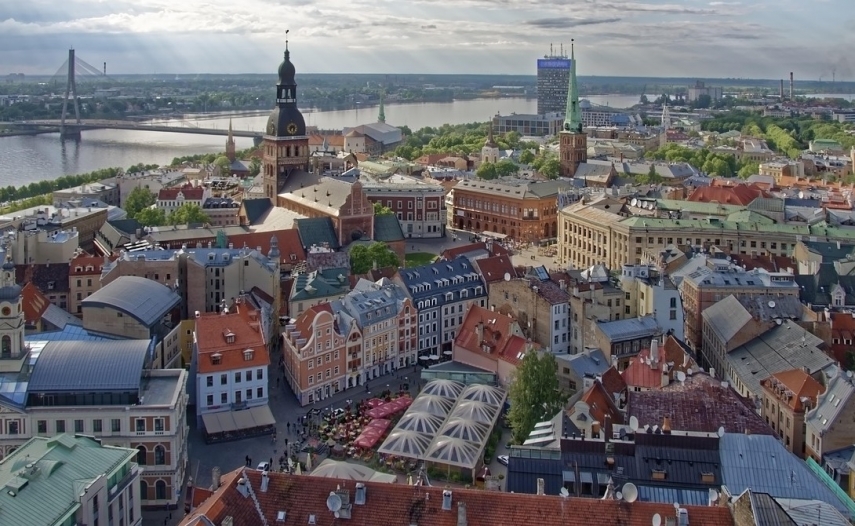
RIGA - Internal estimates made by several Russian institutions confirm that sanctions have already inflicted and will continue to create losses of up to several hundred billion USD to Russia's economy, according to the Constitutional Protection Bureau's report "Western Sanctions Cause Significant Losses for Russia's Economy".
The report says that despite Russia's public announcements claiming its economy is successfully adapting to the impact of the Western sanctions, internal estimates made by several Russian institutions confirm that sanctions have already inflicted and will continue to create losses of up to several hundred billion USD to Russia's economy.
Although it is unlikely for Vladimir Putin's regime to openly speak of its own problems and challenges, intelligence shows that Russian institutions are creating internal estimates on both the actual and potential impact of the Western sanctions. Russian institutions usually create such estimates to assess specific trends in various economic sectors, says the report.
After Russia's invasion of Ukraine Russia has lost approximately USD 130 billion (USD 32.5 billion annually) in order to buy sanctioned Western goods that were much cheaper for Russia to buy directly from the West before the war. This estimate does not account for cases in which Russia was not able to find a substitute for the particular Western good.
Due to sanctions several Russian economic sectors have lost significant export markets in the West, and Russia has not been able to find alternative markets even by 2026. For example, the comparison of 2021 and 2025 export data shows that Russia's export of iron ores has been reduced by 40 percent, iron and steel by 20 percent, chemical products by 35 percent, while timber and cellulose by even around 50 percent.
Contrary to Russia's public claims, internal forecasts by Russian institutions indicate that Russia will not be able to substitute the lost markets even over the next five years.
Intelligence indicates that Russia is both assessing the existing losses and also attempting to predict future economic risks. According to Russian estimates, by 2030, various risks, including the Western restrictions, could reduce Russia's foreign trade by approximately USD 175.5 billion (approximately USD 35 billion annually), which is around 5 percent of the overall volume of Russia's current foreign trade.
The estimates show that the largest risk - loss of USD 136 billion - is caused by Western restrictions, including direct sanctions on Russian businesses and industries, secondary sanctions against Russia's trade partners, embargo on trade with Russia, as well as the US trade tariffs.
According to intelligence, Russian forecasts indicate that it could lose at least USD 70 billion due to the trade policies of European countries, if Europe continues to refuse to trade with Russia, by restricting both imports and exports.
Russia is also especially worried about the Western pressure on its current trade partners - secondary sanctions, tariffs and other restrictions that hinder Russia's trade with non-Western countries, for example, restrictions on the trade infrastructure between Russia and its partners.
Even though Moscow does not talk about it openly, the regime acknowledges that many of its trade partners consider Russia a toxic counterpart. Thus, the cautiousness of the so-called "friendly countries" to develop their economic relations with Russia is seen by the Kremlin as one of the main factors that amplifies its potential economic losses.
Although Russia's own estimates already confirm the current and potential losses worth several billions of USD, the Constitutional Protection Bureau assesses these estimates to be an undercount - the losses are likely much higher.
Such estimates tend to include only the direct effect of sanctions or calculate the losses in specific sectors, instead of the entire economic spectrum, not accounting for indirect effects like reduced income from taxation, increased prices for Russian population, and others.
Another estimate by Russian institutions shows that if the Western pressure increases, over the next five years, it will result into losses of around USD 216.5 billion for the energy sector alone (approximately USD 43.3 billion per year).
Russian officials believe that Russia will face such losses if the European Union implements a full energy embargo and countries like China, India and Turkey diminish their imports of Russian oil and gas.
These estimated losses exceed those foreseen by Russian institutions for the foreign trade as a whole, which confirms that the overall forecast must be regarded as conservative.
The situation in the global markets can also significantly influence potential risks for Russian economy. Various trends can either reduce or increase these risks. For example, the currently high oil and gas prices, caused by the conflict in Iran and the Strait of Hormuz crisis, provides Russia with additional income from energy exports, thus widening Russia's fiscal space at least in the short term.
However, it does not change the structural problems that Russia's economy faces due to the war in Ukraine and sanctions, and they will continue to create losses and new risks for Russia's economy in the long term.
Russia's own economic estimates confirm that most people within Putin's regime, including high-level officials, are aware of the significant economic problems the war in Ukraine and the following sanctions have created for Russia and their impact on the country's development in the long term.
At the same time, intelligence shows that, despite the existence of such estimates, Russian institutions base their reports and assessments of the economic situation on official propaganda narratives, likely to present their own activities as more efficient.
For example, any report starts with statements like "Russia's economy is successfully overcoming sanctions", "Russia strengthens its role as one of the power centers of the multipolar world", "Russia has effectively re-oriented its trade from the West to friendly countries".
It is likely that that the main decision-maker in the Kremlin - Vladimir Putin - receives biased information on Russia's economic developments, which emphasizes the narratives on successful economic developments, without highlighting the problems and risks that have been identified by Russian institutions, says the Constitutional Protection Bureau's report.
Such reporting is highly likely strengthening Putin's confidence that sanctions' impact is of secondary importance, especially in comparison to his obsession with gaining control over Ukraine. Therefore, Putin is unlikely to change his aggressive foreign policy course even in a scenario of aggravated economic crisis in Russia.
Russian officials responsible for economic policies have accepted that they are not able, or willing, to change the current situation, and must, therefore, adapt their work to the conditions of ongoing confrontation and sanctions.
Russian institutions continue to assess losses and potential risks to the country's economy, but they do not question the main cause for the economic problems - the war in Ukraine. Instead, they continue to create various plans for the modernization and diversification of Russia's economy, knowing very well that Putin's foreign and military policies will remain the main obstacle for such plans to ever be realized.
Russia's own estimates prove that Western sanctions and other economic restrictions are an effective tool for constraining Russia. They have significant negative impact on Russia's economy which costs at least several hundred billion US dollars.
At the same time, the full potential of the sanctions has not yet been realized, they can be extended in order to stifle Russia's future economic opportunities.
However, the West has to be realistic in its expectations regarding the sanctions. Sanctions alone will not change the confrontational course of Putin's regime or force Russia to stop its unjustified war against Ukraine. They are, however, effective enough to reduce the financial resources Russia needs to sustain its war effort and military rearmament for new conflicts, including against NATO.
Sanctions alone cannot change Russia's aggressive intent, but they are already limiting its capabilities to actually realize this intent. Russia has been attempting to achieve the cancellation of the Western sanctions through various channels, especially in the context of the ongoing diplomatic negotiations on the possible settlement for the war in Ukraine.
The Constitutional Protection Bureau assesses that the lifting of sanctions will significantly increase the threat posed by Russia not only to Ukraine and Europe, but also globally.
Even partial easing of sanctions would provide Russia with additional financial opportunities to accelerate the tempo of its military rearmament, allocate resources for influence campaigns around the world, and increase its support to hostile anti-Western countries like Iran, North Korea, Venezuela and Cuba, or finance paramilitary groups in Africa. Such developments would increase the risk of destabilization in many regions around the world.

Please enter your username and password.

2026 © The Baltic Times /Cookies Policy Privacy Policy