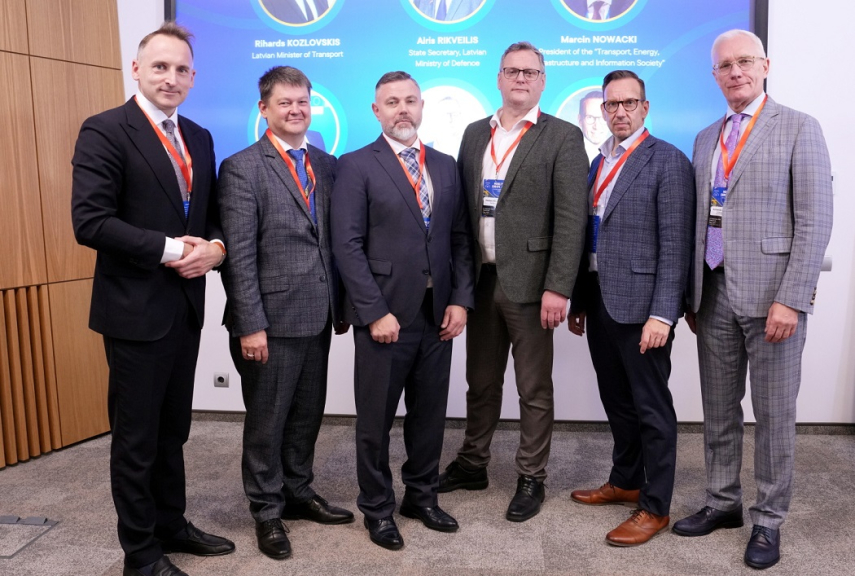
RIGA - The incursion of foreign drones into Latvian airspace on Thursday is not the first such incident in the country and is a direct consequence of Russian aggression, European Parliament (EP) Member Sandra Kalniete (New Unity) stressed at the opening of a discussion, "The future of European security: a perspective from the eastern flank" in Riga.
The MEP noted that both Russian and Ukrainian drones have entered Latvian airspace before. In her view, such incidents will continue. Kalniete said that some of these incidents were deliberately created to test the reaction of European Union (EU) member states and to sow fear in the population, while others were accidents, also due to electronic warfare.
Kalniete mentioned that at a joint meeting of the EP committees, she asked NATO Secretary General Mark Rutte what he would do during his mandate to protect the Baltic states and NATO's eastern flank from possible Russian aggression. Rutte reportedly stressed that a clear message must be sent continuously that in the event of an attack it will not be just the Latvian armed forces that will resist, but the whole alliance.
The MEP stressed that NATO and the EU do not have second-class citizens or countries. In her view, it is important to realize that collective defense is indeed common defense and that all member states are interlinked. Kalniete stressed the need to continue efforts to strengthen the bloc's eastern flank, especially in the wake of regional security disruptions. The MEP noted that concrete actions and robust defense capabilities should be demanded from NATO leadership.
Andrzej Halicki, deputy head of the European People's Party group in the EP and head of the Foreign Affairs Working Group, expressed hope that the next EU budget will include a fund for the bloc's border regions, businesses and local communities to boost business competitiveness and ensure a better standard of living.
Halicki stressed that Europe will not be secure without the protection of its eastern borders and noted that today in Warsaw, Poland, a security agreement is being signed between the government and the European Commission on the implementation of physical border protection, including projects such as the European Drone Wall and the East Shield.
The Polish MEP noted that hybrid warfare is an everyday reality in Eastern Europe, with drone attacks, disinformation campaigns, and acts of sabotage.
As reported, a discussion organized by the Foreign Policy Working Group of the European People's Party (EPP) group in the EP took place in Riga on Friday. Kalniete is the chair of the working group, and the event took place at her initiative.

Please enter your username and password.

2026 © The Baltic Times /Cookies Policy Privacy Policy