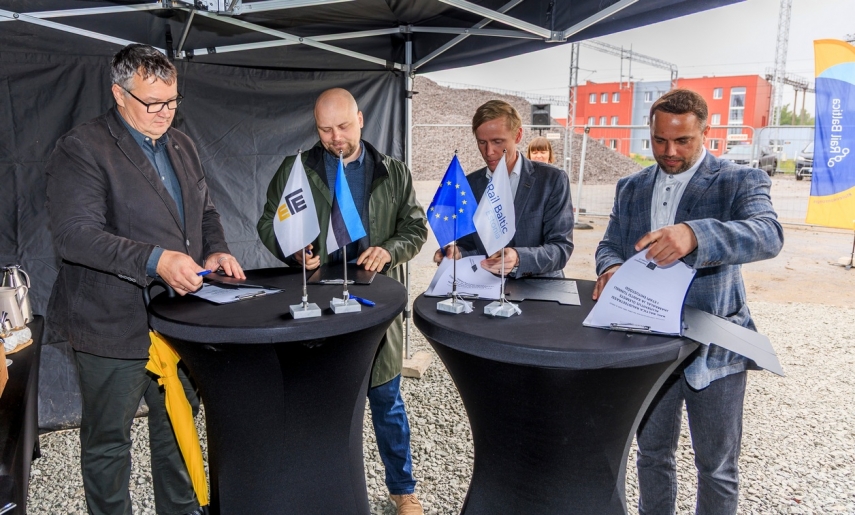
Rail Baltic Estonia, the City of Tallinn, and construction company LEONHARD WEISS OÜ have signed a €9.8 million contract for the construction of the Rail Baltica Ülemiste station area substructure and the first phase of the Kantsi Tunnel. The tunnel will create a new connection between Lasnamäe and Ülemiste and contribute to the development of one of Tallinn’s most important growth areas into an international transport, business, and service hub.
According to Anvar Salomets, Chairman of the Management Board of Rail Baltic Estonia, the project marks an important milestone in the development of the entire Ülemiste area.
“The Kantsi Tunnel is much more than a railway underpass. It is part of a larger vision that will transform the Ülemiste area into Estonia’s most important international mobility hub. Rail Baltica will not only connect us with Europe but will also improve links between different regions of Estonia and Tallinn, creating opportunities for new investments and jobs,” said Salomets.
Aleksei Dohin, Procurator and Director of the Civil Engineering Division at LEONHARD WEISS OÜ, said that the contract represents an important stage in the development of both Rail Baltica and Estonia’s railway infrastructure.
“The contract for the construction of the Rail Baltica Ülemiste station area and Phase I of the Kantsi Tunnel is an important step in the development of Estonia’s railway infrastructure and the implementation of the Rail Baltica project as a whole. We are pleased to apply our extensive experience and expertise to this strategic project, which will improve regional connectivity, increase safety, and create new opportunities in the future.
LEONHARD WEISS OÜ has participated in several Rail Baltica infrastructure projects in Estonia, Latvia, and Lithuania, including the construction of the Ülemiste pedestrian and cycling tunnel, the expansion of railway infrastructure at Riga Central Station, and the construction of the Šveicarija–Žeimiai railway section,” said Dohin.
For cars, pedestrians, and cyclists
At present, access to the Ülemiste area is primarily provided via Tartu Road, while the next railway crossing is located more than three kilometres away on Smuuli Road. Once completed, the Kantsi Tunnel will create a new connection between Peterburi Road and Suur-Sõjamäe Street, improving access for pedestrians, cyclists, public transport, and motorists alike. Currently, the railway can only be crossed at this location via a pedestrian bridge.
The contract signed between Rail Baltic Estonia and LEONHARD WEISS OÜ is valued at €9,826,169. In addition to the Kantsi Tunnel, the contract includes the construction of a new passenger platform and access routes, as well as the substructure for the Rail Baltica European-gauge railway infrastructure within the Ülemiste station area, including embankments, drainage systems, and necessary utility networks. The deadline for completion of the first phase is 31 October 2027.
Ülemiste growing into Tallinn’s new centre
The Kantsi Tunnel is only one part of a much larger development. Over the coming years, Rail Baltic Estonia, Tallinn Airport, and Mainor will invest nearly €500 million in the Ülemiste area. The goal is to transform this former industrial district on the edge of Lasnamäe into a modern urban centre that complements Tallinn’s historic Old Town and the Telliskivi Creative City.
Already today, Ülemiste City ranks as Estonia’s third-largest economic city based on labour tax revenues. By 2030, 25,000 people are expected to live, study, and work in the district.
The Linda Terminal, designed by Zaha Hadid Architects, is scheduled for completion in 2028. Together with Tallinn Airport, Ülemiste City, and the planned European Park, the area is expected to become an attractive gateway to Estonia for international companies and investors.
About Rail Baltica
Rail Baltica is one of the largest high-speed rail projects in Europe and is part of the Trans-European Transport Network. It aims to improve connectivity, strengthen regional security and support economic growth in the Baltic states. The new railway will link Estonia, Latvia and Lithuania with Poland and, indirectly, with Finland, as well as with the broader European rail network.
Rail Baltica will be fully electrified with a standard gauge of 1435 mm and it will be equipped with ERTMS (European Rail Traffic Management System). It has been designed to meet European standards. With a design speed of 249 km/h, Rail Baltica will reduce travel times between the Baltic states and major European cities by more than half. It will serve as a modern infrastructure for passenger, freight and military mobility, promoting accessibility and facilitating business, tourism and cultural exchange. Rail Baltica will help establish the Baltics as a key link in European trade and cooperation.

Please enter your username and password.

2026 © The Baltic Times /Cookies Policy Privacy Policy