VILNIUS - Belarusian human rights activist and Nobel Peace Prize laureate Ales Bialiatski, recently released from prison, said it is impossible to reach an agreement with President Alexander Lukashenko to end repression or restore even minimal democratic norms.
“Knowing this regime and Lukashenko since the beginning of his political career, I have no doubt that it is impossible to agree with him on ending repression and returning Belarus to even minimal democratic norms, just as it is impossible to tear him away from Russia’s sphere of influence, because he is part of that sphere; he is destroying the independence of Belarus,” Bialiatski said in Vilnius on Thursday.
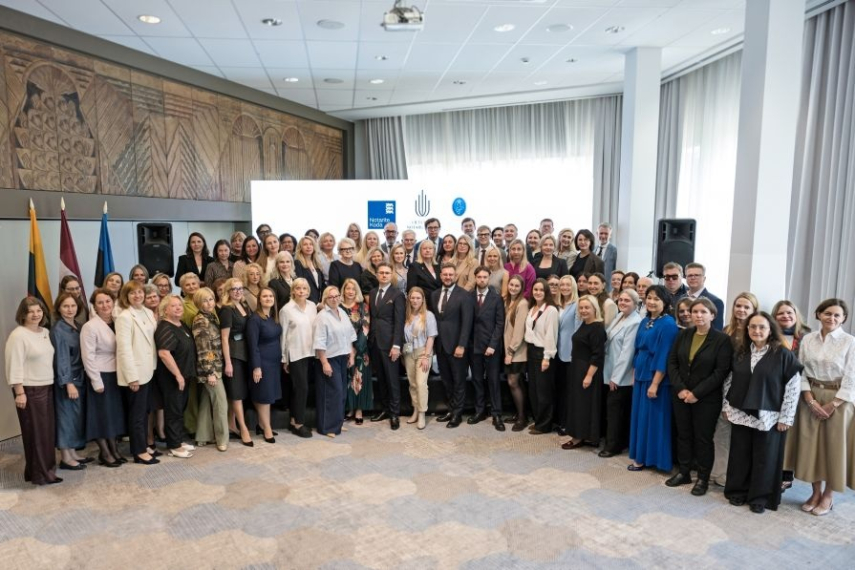
Bialiatski was attending a commemoration at the Seimas marking the 40th anniversary of the Chernobyl nuclear disaster.
“Forty years ago, the Chernobyl catastrophe occurred; 20 percent of Belarusian territory was covered in radiation, and a million people were forced to leave their homes. My mother’s native village remains empty to this day, now overgrown with forest. Chernobyl became a painful trauma for the entire Belarusian nation, but when Lukashenko came to power, a political Chernobyl began in Belarus,” the Nobel laureate asserted.
He described the Astravyets Nuclear Power Plant, built near the Lithuanian border on Kremlin orders, as a manifestation of hybrid warfare aimed at destabilising Eastern Europe.
The activist recalled that the Viasna Human Rights Centre, which Bialiatski has led for many years, was founded in 1996 during a mass demonstration marking the tenth anniversary of the Chernobyl disaster.
“Although several hundred political prisoners have been released from Lukashenko’s prisons in recent years, including through forced deportations—which I also experienced—about 900 people are currently imprisoned for their political views. Every day brings information about new political detentions, searches, and sentences. These are planned actions by the regime intended to intimidate society and recruit new lives for political bargaining with Western democratic countries,” he said.
However, the former political prisoner stated that the Belarusian people have not been brought to their knees and are resisting Russian aggression against Ukraine, which is why Lukashenko did not dare send troops into Ukrainian territory.
Bialiatski said he supports Lithuania’s initiative to prosecute Lukashenko, often called Europe’s last dictator, for complicity in war crimes.
The Nobel laureate thanked Lithuania for providing refuge to thousands of Belarusians forced to flee their country.
On the other hand, he requested that their rights in Lithuania not be equated with those of Russian citizens.
“I hope that the Lithuanian state will continue to favourably resolve the issues of their legalisation and adaptation, without equating Belarusians to Russian citizens,” Bialiatski said.
Furthermore, he urged the continuation of sanctions against the Minsk regime.
“If it were not for these sanctions, I would still be in prison,” the Nobel Peace Prize winner said.
Bialiatski was released from prison in Belarus last December along with 121 other political prisoners. US presidential representatives have been negotiating with the Minsk regime for the release of political prisoners.

Please enter your username and password.


2026 © The Baltic Times /Cookies Policy Privacy Policy