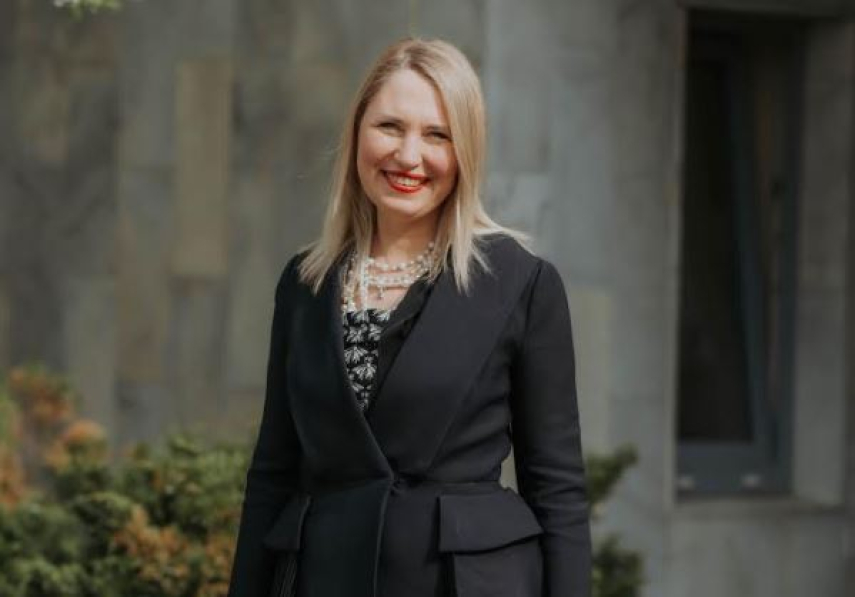
RIGA - The Baltic states acted very appropriately by ensuring transparency regarding the threat to their undersea infrastructure and by cooperating closely with their allies to neutralize this threat, said Elisabeth Braw, a senior fellow at the Atlantic Council and a member of the UK National Preparedness Commission, in an interview with LETA.
The author of the forthcoming book The Undersea War, which focuses on threats to undersea cables and pipelines, acknowledged that cable and pipeline infrastructure - especially cables - is an area where we remain vulnerable, as the cables lie on the seabed and have no protection whatsoever.
The only protection is the proper action of nations and maritime traffic participants - ships and all others. "We have now reached a point where we can no longer be certain that ships sailing in our waters will take care not to damage the cables, she said, acknowledging that we may never know whether, if a cable is snagged by an anchor, and if this was done intentionally or not," she said.
The expert assessed the Baltic states' response to incidents on the seabed of the Baltic Sea very positively. "In my opinion, the Baltic states are doing the right thing by ensuring transparency regarding these threats. It is essential to gain public support, and that is something all three Baltic states have done well. It is also necessary to cooperate closely with allies, but one's own public must definitely be involved in this process," said Braw.
The expert noted that in recent years, during several serious incidents involving undersea cables in the Gulf of Finland, the Estonians and Finns cooperated very closely to coordinate their responses, while the Latvians cooperated very closely with the Swedish government when a cable belonging to the Latvian Radio and Television Center was damaged, as it was a cable connecting Latvia and Sweden.
"It is precisely in such cases that radical openness and transparency are crucial. If the crew of the vessel that snagged the cable truly acted so carelessly that they severed the cable accidentally, then we should name that crew and ensure that everyone knows that these specific people caused the accident or incident, which could have significantly impacted, for example, Latvia's ability to function. After all, we need digital connectivity every day, every second," Braw said.
She specifically praised Latvia for implementing a national security education program in high schools, as Latvia is a step ahead of everyone else in this area.
"Latvia has the most comprehensive curriculum in this area; it is something other countries can learn from. This is also linked to transparency - teaching and educating young people about national security and how they can contribute to ensuring it," said Braw. Everyone has a role to play in helping to protect their country, even if it is something very small, such as verifying information before sharing it on social media.

Please enter your username and password.

2026 © The Baltic Times /Cookies Policy Privacy Policy