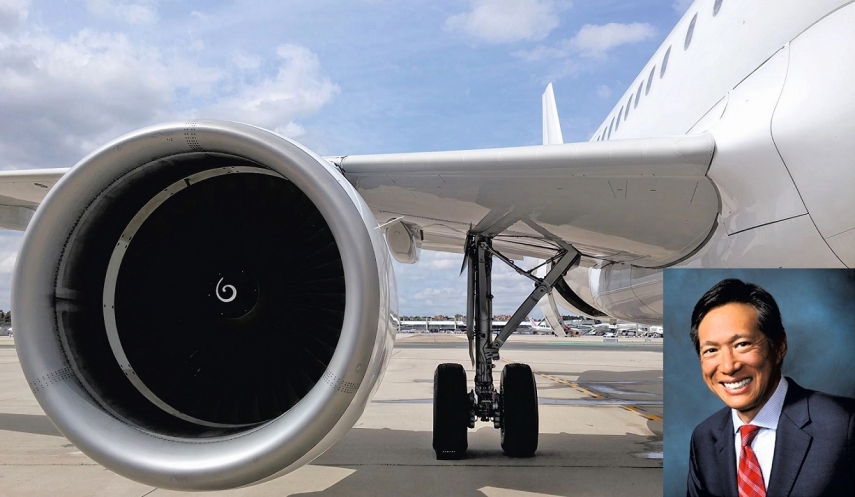
Photo: Avia Solutions Group Executive Emzon Shung
After more than two decades in aviation, US businessman Emzon Shung now leads the aviation asset management company WOLF Holding. Although the firm was established by Avia Solutions Group only this year, its intended role in the group’s strategy is highly ambitious. The company is currently seeking to raise USD 500 million, opening the door for third-party investors to invest in aircraft and aircraft engines. According to Shung, being part of a global aviation group – combined with the fast-growing ACMI (aircraft, crew, maintenance and insurance) sector – creates a unique value proposition in the asset management industry.
You’ve spent decades in aviation. How did it all begin?
I had long been fascinated by aviation, and about 20 years ago I obtained a private pilot’s licence. Later came a private aircraft maintenance business, and in 2005 my partners and I acquired an airline in Israel and began building our own aircraft leasing business. We bought brand-new aircraft – Boeing 787s, Airbus A321neos, A330neos – and leased them to airlines around the world.
After decades in the industry, I met Gediminas Ziemelis, the founder and chairman of Avia Solutions Group, and I was very intrigued by the business model the group was developing. Together we decided to set up a new company focused on acquiring, selling and long-term leasing of aircraft needed in the market. That’s how WOLF Holding was born.
How has aviation changed over the past decades?
There have been countless changes, but I would single out one – the ACMI model. In the past, ACMI was seen as a form of “emergency support” for airlines when their aircraft were grounded due to technical issues or other disruptions. Today it’s completely different – ACMI has become a strategic tool for planning fleets, routes and managing seasonality. Depending on the region, airlines face major fluctuations in demand caused by school holidays, major celebrations and peak travel periods. That is the main driver of growth for this business.
ACMI is booming. How much of this was driven by the pandemic and sudden demand swings?
Although ACMI existed before, the real growth of this model – and of Avia Solutions Group – began during the pandemic, when demand for cargo flights surged. Later came supply chain issues, causing shortages of new engines and aircraft. This triggered a boom in demand for passenger ACMI services – today the group’s companies mostly work to meet this need.
How has this changed the way leasing companies see opportunities in the ACMI market?
Most aircraft operated by Avia Solutions Group are leased from 41 companies worldwide. Lessors are actively offering aircraft both to us and to other ACMI operators. This creates an interesting situation: ACMI growth is constrained by the supply of aircraft. In other words, Avia Solutions Group could grow even faster if we had access to more aircraft. And this is precisely where opportunities open up for lessors.
You’ve mentioned how the company was established, but why did Avia Solutions Group decide to create WOLF Holding?
There are two main reasons. First, it enables the group to expand even further in the aircraft leasing market. The group already offered ACMI, maintenance, pilot training, ground handling and other services, and now we’ve added long-term operating leasing. In essence, we’ve completed the picture – what we can offer our clients, how we create value for airlines, and how we secure stable returns for investors.
Second, working with Avia Solutions Group gives us major advantages. The group has MRO (maintenance, repair and overhaul) bases on three continents, operates ACMI airlines in Europe, Asia and Latin America, and provides many other aviation services that are useful for lessors. As part of the group, we have access to MRO capabilities, to the group’s airlines as potential lessees, and to a broad network of partners and contacts that we will use to acquire aircraft and sign leasing agreements.
Our current goal is to raise USD 500 million in investment, which we will use to acquire aircraft and, later, engines. We are in talks with investors from all over the world – although we’ve only recently started, interest is strong.
Access to MRO bases – is this a unique advantage of Avia Solutions Group?
We’re not the only ones with MRO bases. But maintenance is a fairly scarce “commodity” in the market – it’s another limiting factor for lessors. Look at the numbers: there are around 700 lessors worldwide with 10 or more aircraft, and another 100 large lessors. But the number of lessors with their own MRO facilities can be counted on one hand. And when you add a strong ACMI fleet on top of that, the situation becomes truly unique. Even if others have ACMI capacity, Avia Solutions Group’s fleet is four times larger than its closest competitor. That allows us to offer investors a very attractive risk-return profile.
What role does WOLF play in the group’s strategy?
To understand our role, it’s useful to compare us to FL Technics, the group’s MRO provider. Around 10 percent of its services go to Avia Solutions Group companies, while the remaining 90% goes to external clients.
We are not – and don’t want to be – a “captive” lessor working only with group companies. That wouldn’t be sustainable or promising in terms of scale. We aim to grow like every other Avia Solutions Group business – as an independent company capable of standing on its own. But being part of the group enables us to achieve even better results.
How do you see the future of the aviation sector? What major trends do you observe?
Passenger markets will continue to grow as global GDP and population increase. The road may be bumpy – just think of COVID-19 or the 2007–2008 crisis – but the long-term trends are clear. There were predictions that after COVID no one would travel for business anymore because everything could be done via video call. That didn’t happen – people want to meet in person. Aviation enables that better than any other industry.
What about cargo transport?
The growth of cargo flows is another important trend. Goods move wherever demand exists, and high-quality, reasonably priced products will always be in demand. Air cargo helps meet this demand, and high-value goods and components are usually flown because it is safer and faster.
Do you see aviation purely as a business?
Aviation is more than a business and more than aircraft. It is infrastructure that keeps the world functioning – it enables economic growth, cultural exchange and diplomatic relations between countries. This is especially important for smaller nations – aviation allows their citizens to travel freely, attend meetings and events around the world. You’ll notice that people from small countries tend to travel much more. Look at Iceland – Icelanders are everywhere! The same is true of Norway, Israel and, of course, Lithuania. There are only three million Lithuanians, yet you can meet them across the globe – and aviation makes that possible.

Please enter your username and password.

2026 © The Baltic Times /Cookies Policy Privacy Policy