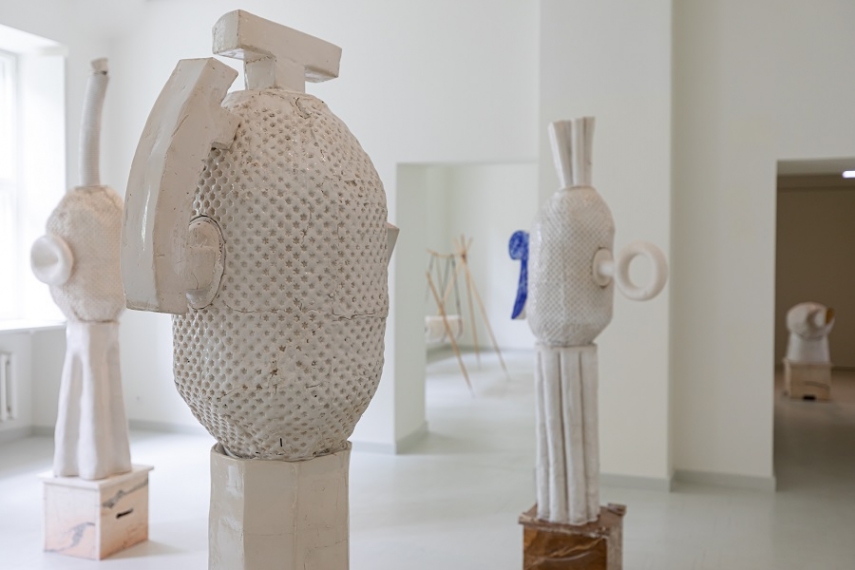
Photo: Sculptures by Mindaugas Navakas (by Gintarė Grigėnaitė-LNMA)
On 2 April, at 6 pm the Radvila Palace Museum of Art of the Lithuanian National Museum of Art opens the Yesterday and Long Before – an exhibition by one of the foremost Lithuanian sculptors Mindaugas Navakas. After five years the artist returns to the Radvila Palace with a new edition of several dozen most recent monumental sculpture pieces in porcelain. A part of this collection is presented to the public for the first time.
Mindaugas Navakas (b.1952) has branded himself primarily through his large-scale sculptural objects of unexpected, often bewildering shapes. Of his pieces, naturally integrating into outdoor urban spaces, the most cited ones in the city of Vilnius are his massive The Hook, protruding from the pediment of the former soviet Railway Workers Culture House, a group of Four Large Reliant Sculpture Pieces outside the MO Museum, and The Two-Storey on the embankment of the River Neris.
“Navakas’s art, which has been a significant contribution to the development of the Lithuanian sculpture, especially catalyzing its reinvention before the dawn of the Lithuanian independence, continues to surprise through its prodigious variety of materials, forms, ways of expression, its profound and critical take on the immediate setting and its cultural contexts. The porcelain sculpture pieces which return to the Radvila Palace with the exhibition Yesterday and Long Before, appear as a summing-up of an entire phase of the artist’s career, simultaneously entering into new dialogues with the space of the hosting building, its multilayered and complex past, as well as the museum it is presently home to”, says Justina Augustytė, director of the Radvila Palace Museum of Art.
History and time as revisited by the artist
The artist emphasizes that the porcelain used to create the sculpture pieces on display is sourced from the factory in Sloviansk in the Donetsk region of Ukraine, which is currently closed due to the ongoing war.
“The works produced from 2018 through 2022 from the hard paste porcelain, glazing and other different materials this time are showcased in a building with the features of Historicism. Thus, the event is conceived as an impact of the space with its authentic details interacting with the pieces of sculpture rhythmically arranged in that space by the artist himself. The exhibition actively evokes the cultural and historical context of the porcelain as material, emphasizing, alongside, its present geopolitical connotations. The show also functions as a retrospect of a single creative series by the artist,” the exhibition curator Viltė Visockaitė introduces the context of the event.
In line with the conception, the exhibition is intentionally set in the grand hall of the southern wing of the Radvila Palace Museum of Art – the part of the building the completion of which was hindered until the early 20th century by recurrent military conflicts. It is in this space that the porcelain works, stripped of any magnificence, evoke a revisited perception of history and time, unravelling, by the same token, the myth of dreams about a grand palace.
The imperfection of the porcelain
Throughout his career, Navakas has retained his characteristic critical and often ironic stance, but his plastic idiom, though recognizable to many, is being constantly reinvented. His art is a testing ground of experiments with the techniques and materials he uses to create his pieces – from the traditional materials of metal, wood, stone – to ready-mades he ingeniously incorporates into his pieces.
In the exhibition Yesterday and Long Before the artist’s experiments go on: he uses the hard paste porcelain, but shapes the surface of his pieces from the standard industrial materials as a means to articulate all kinds of contrasts between the East and West – economic, social and cultural. For instance, in China, porcelain is usually associated with vases, China sets and tableware, while in the West, it is used for the production of sanitary ware and becomes part of hygiene infrastructure.
“To create form, I use very simple, cheap and standard industrial materials. I find not what is close at hand, but what emerges in a process of intent looking. I turn them into porcelain, these commonplace, trivial materials, and this act of transformation for me is key,” says the artist.
Navakas’s art reveals the other side of porcelain as material: in contrast to the ideally smooth surface of mass production, he relishes in imperfect forms, cracks and textures. This intentional imperfection, in fact, speaks loads of the qualities of porcelain as material, and the process of its shaping and firing.
---
Mindaugas Navakas has been intensely exhibiting since 1977 in Lithuania and abroad. His artwork appeared in the 1st Gwangju Biennale in South Korea, while in 1999, he (together with Eglė Rakauskaitė) was the first artist to represent Lithuania at the 48th International Art Exhibition La Biennale di Venezia. In 1995, he became a recipient of the Herder Prize, in 1999, he was awarded the Lithuanian National Prize for Culture and Arts, and in 2004, the Baltic Assembly Prize.
The exhibition at the Radvila Palace Museum of Art of the LNMA will run until 2 August. Its experience will be expanded by tours and education events.
Organizer Radvila Palace Museum of Art of the LNMA
Exhibition curator Viltė Visockaitė
Architect Aleksandras Kavaliauskas
Graphic designer Domantas Pigulevičius

Please enter your username and password.

2026 © The Baltic Times /Cookies Policy Privacy Policy