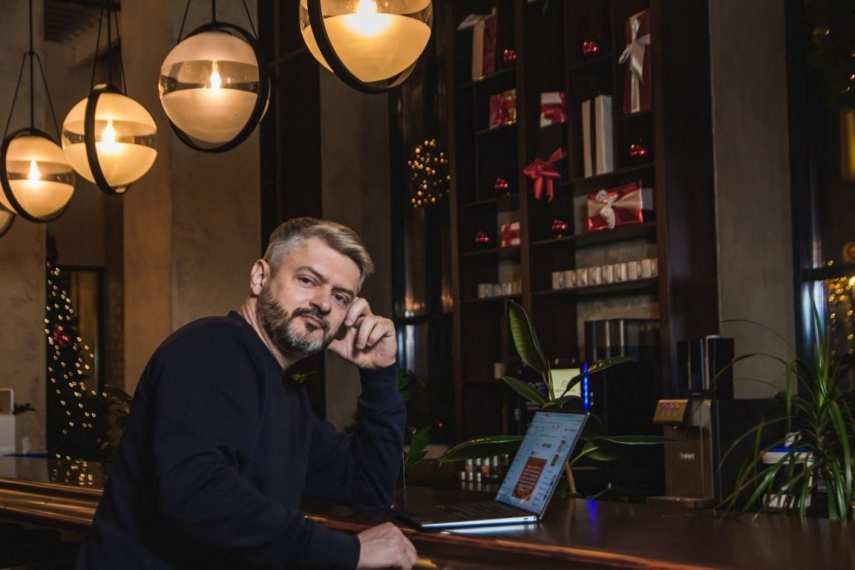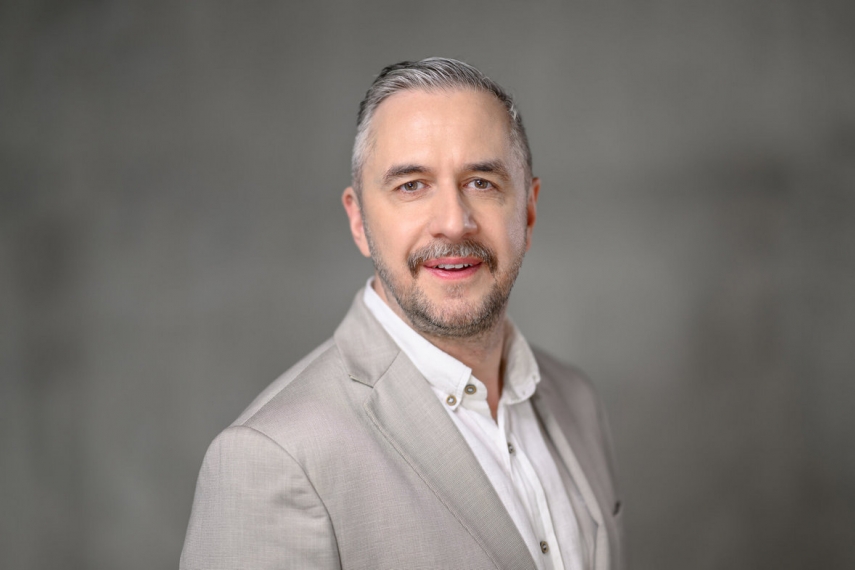
“I would advise twelfth graders to pay less attention to what other people say – other people’s advice isn't always helpful. Try out the field that interests you and study what you genuinely want. I would also encourage them to volunteer as much as possible and gain as much experience as they can, which will give them something real to rely on and help them step back from their parents' projections and the expectation that their children will follow in their footsteps. I believe that every person needs to decide their own path,” says Tomas Vaitkūnas, a graduate of the Education Academy of Vytautas Magnus University (VMU), a history teacher at Vilnius Vytautas Magnus Gymnasium, and a teacher at the VMU “Gifted” Centre.
The educator, who received the Meilė Lukšienė Prize in 2025 for promoting the ideas of democracy, community, civic responsibility, humanism, and creativity, shared his thoughts on the joys of teaching, the receptiveness of today’s pupils to technology, and his memories of his study years.
When applying to the then Lithuanian University of Educational Sciences (now the VMU Education Academy), Tomas says he did not even consider other options, although his academic achievements would certainly have allowed him to study elsewhere. What attracted him the most were the Bachelor’s programmes in History and in Pedagogy, which he saw as a kind of bridge to psychology and to connecting with people.
“I wanted to combine two things that were important to me: history and psychology. Working with people enables you to be dynamic: you not only get to know them, but you also get to tell the stories of people from the past. It’s a very appealing prospect,” the teacher recalled, reflecting on his motivation at the time. Among the lectures that left the strongest impression, Tomas mentions the study of the European Middle Ages – both because of the fascinating subject matter and because of the erudition and distinctive teaching style of teacher Darius Alekna.
In search of greater meaning in work
Tomas Vaitkūnas’s path into teaching was not a straight one – by the end of his studies, the desire to become a teacher had somewhat faded, so Tomas decided to work in the private sector. Later, however, he realised that he wanted to teach, so he returned to school in search of greater meaning in his work.
“The work is very dynamic, and every lesson is unique, because the pupils are different and you yourself come in with different energy, mood, and thoughts. The work is not only far from dull, but you also learn a great deal of new things and get to know hundreds of pupils, personalities who are often unpredictable. That, too, creates a sense of joy and excitement,” notes the history teacher at Vilnius Vytautas Magnus Gymnasium.
Alongside his work at school, Tomas Vaitkūnas teaches at VMU Gifted, an educational centre for gifted children where activities are more informal and different from those in regular institutions. Here, pupils get more hands-on experience, for example, learning about different cultures by role-playing the United Nations and representing various countries.
“We try to understand how such different representatives of Western, Chinese, Islamic and other civilisations can coexist. We simulate the United Nations Security Council, where we address global issues. Pupils vote and present arguments for or against particular decisions, for example on climate change, and tackle problems such as cyberterrorism,” says the VMU alumnus.
Curiosity, empathy, and willpower are essential qualities
Reflecting on the qualities he believes are the most important for those wishing to become teachers, Tomas emphasises that curiosity and empathy prove particularly useful. “If the spark of curiosity were to fade, it would be difficult to convince others that you are genuinely interested. So you have to take an interest in many different things. You also need to be open enough to accept the people in your classroom. And you also need willpower, because the work requires considerable effort, both in preparing for lessons and in delivering them,” he explains.
Tomas is full of praise for today’s pupils – in his view, young people are curious, inclined to take on leadership roles, and able to apply modern technologies creatively. “I am truly delighted with this generation: like all generations, it has its own challenges – in this case, maintaining attention for longer periods of time. However, they also have their strengths – for example, they are quite receptive to information. We simply need to encourage their strengths and prevent their weaker traits from taking hold,” he notes.
Artificial intelligence as a useful tool for teaching
Today, digital technologies, including artificial intelligence, have become inseparable from teaching, as they have from many other professions. Tomas emphasises that school is precisely the place where pupils can learn to use AI effectively, for example by using it for more mechanical tasks to save time, but not overusing it in creative work.
“Overall, I would consider artificial intelligence to be useful for teaching. The interaction between the teacher, AI, textbooks, parents’ input, museums, and other resources creates quite a good symbiosis, synthesis,” says the history teacher at Vilnius Vytautas Magnus Gymnasium, who combines traditional and modern methods in his work.
An interest in history since childhood
Tomas did not choose to teach history by chance – he developed an interest in the subject back in childhood, inspired in part by the stories his grandmothers told him about the past. One of the most vivid stories, he says, was about the Lithuanian army during the interwar period.
“When my grandmother was about 12 or 13, she went to Ukmergė to watch a military parade. She said the uniforms were so nice, and the Lithuanian soldiers looked very good and well-kept. And then, she said, those scruffy Soviets – Russians – arrived, all shabby, unkempt, constantly drunk,” says Tomas, highlighting the contrast that remained in his grandmother’s memory between Lithuanian soldiers and the occupying forces.
After work, the teacher finds time for active leisure – running and hiking, including an impressive 700-kilometre trek to Santiago de Compostela in Spain. “I also enjoy hiking in Lithuania and discovering new routes. I also go running because I think that working as a teacher makes it important to have an outlet for emotions and to keep physically fit,” notes the VMU alumnus.

Please enter your username and password.
2026 © The Baltic Times /Cookies Policy Privacy Policy