TUR presents Landscape, a new solo exhibition by Krišs Salmanis, opening on 18 February at 18:00. On view until 21 March, the exhibition presents new work by one of Latvia’s most internationally recognised contemporary artists.
In his practice, Krišs Salmanis often begins with an almost disarmingly simple gesture, which he then tightens into a precise construction where concept and affect closely interact. He works with everyday materials and familiar forms, from plastic windows, fuel canisters, drywall, and workwear, reconfiguring them into objects that read like condensed thoughts. These works carry the atmosphere of lived experience. They are recognisable and slightly unreal at the same time, like something remembered incorrectly or half-dreamt. Humour is present, but rarely functions as a punchline. More often, it acts as a subtle pressure, allowing a small absurdity to reveal how deeply certain habits, aesthetics, and social reflexes have settled into the body.
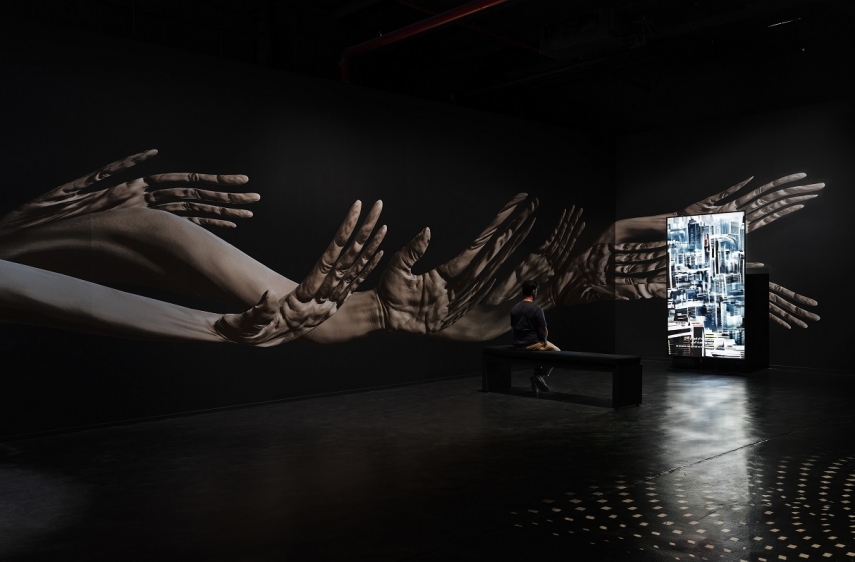
Across sculpture, installation, animation, sound, and moving image, Salmanis repeatedly tests how meaning is built through arrangement and repetition. His constructions move, click, interrupt themselves, and begin again, making the viewer acutely aware of time as a material. In this sense, his works behave like instruments that organise perception rather than illustrations that convey a fixed message. They gather fragments of cultural memory and personal association and hold them in a state of suspension, allowing interpretation to remain open, subjective, and unresolved.
At TUR, Salmanis presents an installation that emerges from his experience as a volunteer in the Latvian National Guard. Within the reserves, participation is defined by a shared objective rather than by individual background. Despite a clear hierarchy of command, daily experience is shaped by a practical equality, where everyone is subject to the same conditions, constraints, and tasks. The exhibition takes the form of a structure that resembles a tent, though it is referred to as a landscape. In this context, the tent functions as a multipurpose object. It is worn as a poncho, transformed into a shelter, and made from similar material as the canvas canopy of the truck that transports reservists to training sites, often located in remote natural environments and unknown to them before arrival.
Its material presence carries sound, movement, and exposure. The flapping of the canvas, the cold, and the uncertainty of where one will end up generate a persistent state of alertness, keeping attention fixed on immediate actions. Only once the shelter is assembled and one lies beneath its protection does perception begin to shift. The surrounding landscape becomes visible, not as scenery, but as the very land the volunteers are trained to defend. In this reversal, the work positions protection as a precondition for reflection. Landscape is not something that precedes structure, but something that is revealed through it.
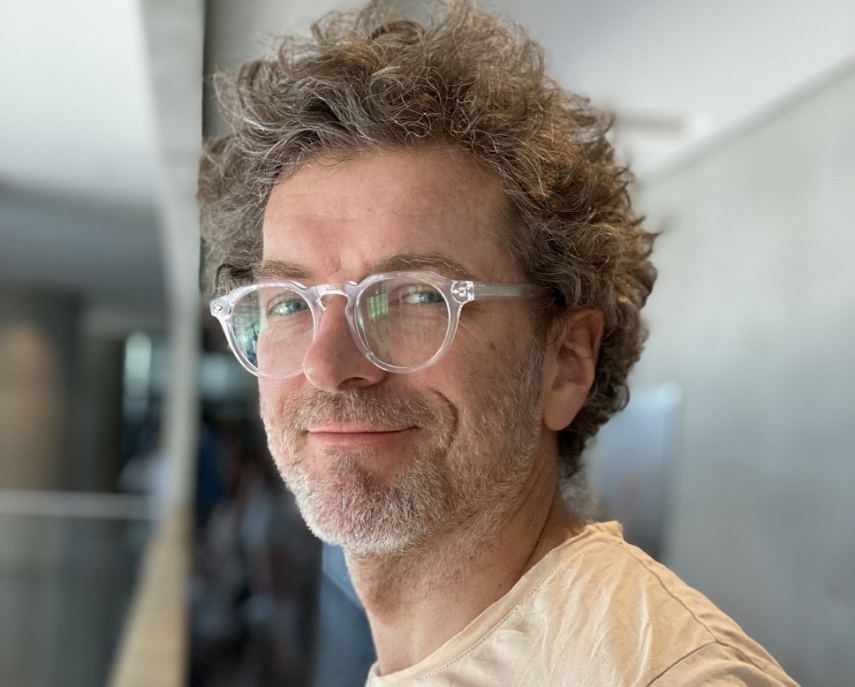
Krišs Salmanis studied visual communication at the Art Academy of Latvia, and his background in three-dimensional thinking and construction continues to inform his interdisciplinary practice. Alongside his visual work, he has collaborated extensively with composers, writers, and theatre makers, and has been active as an illustrator and scenographer. He has exhibited widely in Latvia and internationally, including presentations at major contemporary art institutions such as Kim? Contemporary Art Centre in Riga, Kiasma Museum of Contemporary Art in Helsinki, and the Latvian National Museum of Art. In 2013, he represented Latvia at the Venice Biennale together with Kaspars Podnieks, and in 2015 he received the Purvītis Prize for the exhibition Song, created in collaboration with Anna Salmanis and composer Kristaps Pētersons. Throughout his career, his work has remained grounded in an attentiveness to material culture and the quiet persistence of historical and ideological structures within everyday life, unfolding through restraint and precision rather than spectacle.
Curator: Edd Schouten
Project Manager: Kristīne Ercika
Production Manager: Ada Ruszkiewicz
Graphic Design: Andris Kaļiņins
About TUR
TUR is a contemporary art space shaped by an exchange between artists, curators, and the space itself. Located in a large, cube-shaped area within a post-industrial building, TUR’s exhibitions are not imposed upon the space but emerge from a dialogue with its raw materiality, its scale, light, textures, and evolving conditions. Rather than treating the space as a neutral container, TUR invites artists to engage with it as a collaborator, highlighting a practice of attentiveness and reciprocity.
This approach reflects a broader ethical stance: a rejection of the impulse to dominate or neutralize one’s surroundings which is an impulse long embedded in human attitudes toward land, architecture, and ecology. In contrast, TUR’s curatorial model cultivates sensitivity to context, memory, and form. It proposes that to work with a space is also to listen to it, to acknowledge its histories and its material voice. In this way, TUR’s practice aligns with anti-colonial thinking, a practice of care, refusal, and reorientation.
TUR’s annual program follows a seasonal rhythm: three solo exhibitions in winter, three in summer, and a collaborative group exhibition with a partner European art space from outside of Latvia each autumn. This cycle mirrors the changing atmosphere of the space: introspective and stark in winter; open and expansive in summer; and a Fall exhibition that offers a moment for reflection and international exchange. TUR emphasizes long-term collaboration with artists, from early conceptual stages to final presentation and public engagement. The program incorporates interdisciplinary formats such as artist talk-concerts and other events that open new modes of encounter and understanding.
Since 2024, TUR has deepened its commitment to international dialogue. An artist-in-residence program invites artists to spend time in Riga to research and develop new work and in conversation with TUR and the wider artistic community. TUR also seeks to promote Latvian artists and the thriving Riga art scene by participating in at least one international art fair each year. These outward-facing initiatives form part of a broader strategy to strengthen cultural ties, expand artistic networks, and affirm Latvia’s dynamic presence within the European art landscape.
TUR and this exhibition are supported by VKKF

Please enter your username and password.

2026 © The Baltic Times /Cookies Policy Privacy Policy