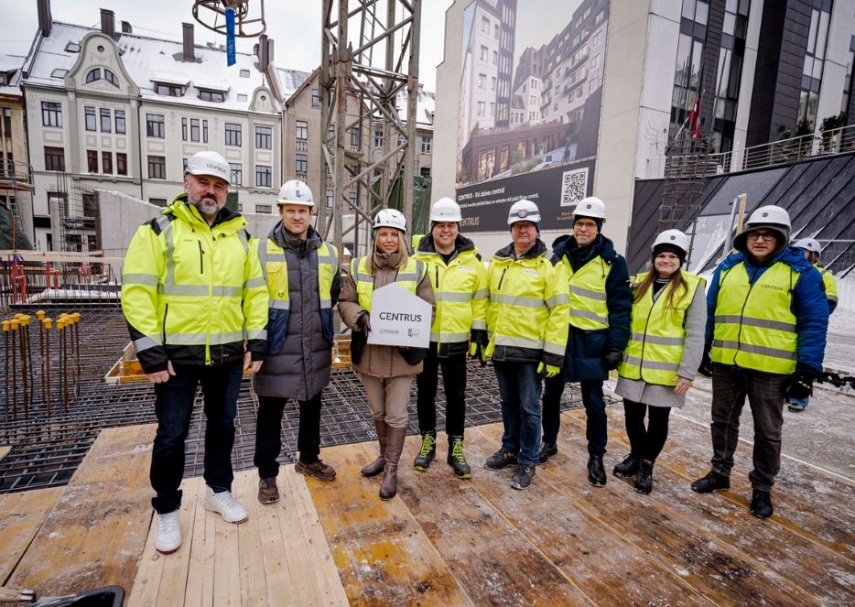

Photo: Mārtiņš Rozenbaums
The real estate bond market has experienced rapid fluctuations over the past three years, from a decline in activity and uncertainty in 2022 to a gradual recovery phase in 2024. The stabilization of interest rates has become a significant turning point: since the beginning of 2024, the market has been reviving, with more new issues appearing and investor interest returning. In 2025, the Baltic real estate bond market has reached new records in terms of both volume and number of issues, exceeding the average annual figure for the last five years several times over (Reference to Signet Bank data).

Akropolis Group's EUR 350 million issue in May 2025 plays in favor for the statistics, and is the largest real estate bond issue in the Baltics in recent years and, with a yield of 5%, serves as a benchmark for the rest of the market. In 2025, other significant capital market transactions were carried out, such as Summus Capital's EUR 30 million bond issue with a yield of 8%, as well as a significant number of transactions involving individual real estate development projects, where funds were raised for the development of specific real estate projects.
Demand exceeded the amount offered
Currently, the capital availability is good, as evidenced by the results of recent real estate bond offerings. In most cases, the total demand for bonds exceeded the amount offered, and in some cases, it was even two or three times higher than the amount the company planned to raise. This may indicate both an attractive offer for investors and a well-structured transaction. Overall, it can be said that if the offer is well positioned and attractive to investors, raising capital will not be a problem, so the main task is always to balance the company's needs with the expectations of investors in a given situation.
Accurate interest rate forecasting is difficult
Interest rates play a significant role in the real estate sector. For example, in 2022, a sharp rise in rates – coinciding with Russia's full-scale invasion of Ukraine – significantly reduced transaction and new bond issuance activity. This trend continued in 2023, when real estate bond yields approached 10% even for companies with stable financial situation, and even higher for riskier projects. With such costs, many developers postponed their projects.
Accurate forecasting is difficult, but current signals so far point to rates stabilizing at their current level and potentially gradually declining in the future. Like other segments of the bond market, real estate bond market rates follow the overall financial markets and depend on the European Central Bank's decisions on base rates. Currently, lower yields than two years ago must be expected, and we may continue to see a gradual decline in rates in the real estate bond market. However, the individual profile of the company remains the determining factor for the interest rate in each bond issue: financial indicators, the quality of the property portfolio, cash flow, collateral structure, and overall risk level.
Who invests in real estate bonds in the Baltics
Both institutional and private investors invest in real estate corporate bonds, and the proportion is determined by the type of offering. Public issues with a lower minimum threshold attract a wide range of private investors, while private placements with a minimum of EUR 100 000 attract a narrower range of investors. The investor structure is also influenced by the issue size, coupon, maturity, collateral and reputation of the issuer.
Institutional investors typically prefer bonds with a lower risk profile and often expect them to be listed on a regulated market. Private investors are more often motivated by yield and tend to be more flexible with regard to other conditions. With the recent increase in private investors' wealth and interest in bonds, the share of public issues has grown significantly, especially in the real estate bond segment. Bonds have also become more accessible to smaller retail investors, who account for a significant portion of the funds raised in many issues.
What bond investors really need to evaluate
The risk for bond investors should be evaluated not only in terms of a specific property or segment, but also in terms of the company's ability to make payments and redeem bonds over time. When analyzing a project, it is important to evaluate repayment or refinancing scenarios and the sources of funds that will be used to implement them. These factors are the ones that most determine the level of risk of the project. In the Baltics, we have previously observed that traditionally, real estate companies operating in the commercial property sector attract financing in the capital market, but recently, more and more residential property projects have also appeared on the market.
It is important to assess the specific risks in both segments: for commercial properties – the planned occupancy rate, the period for achieving it, and rental prices; for residential projects – the progress of reservations and sales, as well as whether these revenues will allow the project to repay the bonds on time.
Capital market potential in the Baltic real estate sector
Signet Bank's investment experts are observing growing interest for capital market financing in the real estate sector, although it must be said that Lithuanian real estate companies are currently the most active in the capital market, followed by Estonia and then Latvia, so we still see growth potential in this area. There are already good examples in the market of real estate developers in neighboring countries successfully implementing projects with the help of bond issues – these examples can serve as practical inspiration for Latvian companies that are still considering taking the next step in the capital market.
About Signet Banka:
Signet Banka is Latvia's leading investment bank, founded in 1991 and one of the first independent banks in Latvia. Signet Banka offers sustainable financing and investment solutions to local entrepreneurs and companies. Since 2021, Signet Banka has attracted additional financing of EUR 1 billion for more than 50 Latvian companies through bond and share issues, while new lending transactions amounted to EUR 500 million. In 2024, the financial resources under management reached EUR 1.6 billion. Signet Banka is the leading organizer of corporate bond and share issues in Latvia and one of the leading stock exchange brokers in the Baltics. Signet Banka's shareholders are twenty-four Latvian and international private investors, the largest of which are Signet Acquisition III (22%), whose sole shareholder is US investor Alexander Solovey, SIA Reglink (14%), founded by banking professional Irīna Pīgozne, and AS RIT Group (11%), a Latvian company owned by the Rapoport family.

Please enter your username and password.

2026 © The Baltic Times /Cookies Policy Privacy Policy