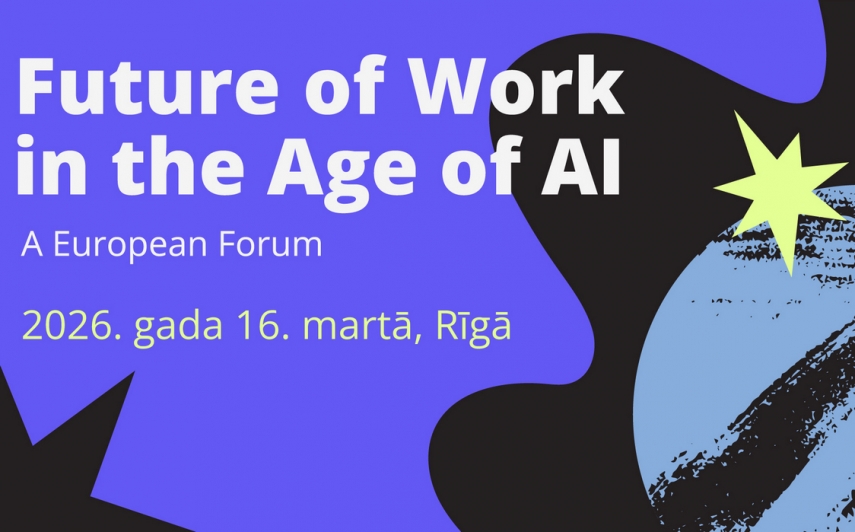
On 16 March 2026, Riga will host the international forum “Future of Work in the Age of AI”, bringing together more than 600 participants and over 60 speakers from more than 20 countries. The Forum will convene European policymakers, business and technology leaders, representatives of education and research institutions, and civil society organisations to jointly address the development of Europe’s workforce amid the rapid adoption of artificial intelligence (AI). More information is available at www.futureofworkeurope.org.
The Forum in Riga is organised by the Future of Work Institute, ERDA, the State Employment Agency of Latvia, and Google. Its objective is to foster cross-sector collaboration and translate strategic discussions into practical solutions that strengthen Europe’s competitiveness, resilience, and social cohesion, while keeping people at the centre of technological change.
Forecasts indicate that generative AI will affect approximately 61% of jobs in Europe, significantly transforming job content and skill requirements, while around 7% of professions will require long-term reskilling. At the same time, economic estimates suggest that the adoption of AI solutions could generate up to €1.2 trillion in additional value for the European Union’s economy over the next decade, provided that timely skills development and workforce adaptation are ensured.
The Forum programme will feature high-level keynote presentations, data-driven discussions, and practical case studies addressing Europe’s skills strategy in the age of AI, competitiveness and the future of work, workforce development forecasts, national growth and AI adoption strategies, digital resilience, lifelong learning models, the role of businesses in skills transformation, the adaptation of education systems to the AI economy, and labour market inclusion. Parallel sessions will explore future skills and learning pathways, the development of new professions and sectors, the potential of creative industries, and the journey of technology from research to market.
Speakers will include Roxana Mînzatu, Executive Vice-President of the European Commission for Social Rights and Skills, Quality Jobs and Preparedness; Annette Kroeber-Riel, Vice President, Government Affairs and Public Policy, Europe, Google; Liza Ateh, Regional Director for Europe, the Middle East and Africa, Google.org; Paul Duan, Founder and President of Bayes Impact; Nicolas Hazard, Founder of INCO; Alizée Lozac’hmeur, Co-Founder of makesense; Tālis Juhna, Rector of Riga Technical University; Minh Huy Lai, Europe Managing Director of Generation: You Employed; Christopher Patnoe, Head of Accessibility and Disability Innovation, EMEA, Google; Valeriya Ionan, Adviser to the First Deputy Prime Minister of Ukraine on Innovation, Digitalisation and International Partnerships; Max Smeets, Co-Director of Virtual Routes; and others. Additional speakers will be announced progressively leading up to the Forum.
According to Evita Simsone, Director of the State Employment Agency of Latvia, Europe’s workforce is changing rapidly, and artificial intelligence is fundamentally reshaping how people acquire new skills and work. In her view, AI literacy will become a prerequisite for everyone entering the labour market or seeking to remain competitive in their profession.
“This is no longer just about using technology – it is about applying it to real-world tasks while developing creativity and problem-solving skills. As AI adoption accelerates, our task is to ensure that workers, employers, and public institutions can adapt simultaneously and fully harness the opportunities these technologies offer,” Simsone said.
Meanwhile, Zane Čulkstēna, CEO of ERDA, emphasises that Europe is simultaneously facing an ageing population, skills shortages, and fragmented education and labour market systems. To remain competitive, it is essential to strengthen cooperation between businesses and educational institutions, expand lifelong learning, and ensure that people have clear and accessible pathways for skills and career development. “Aligning skills with real labour market needs, activating talent in a targeted way, and supporting emerging sectors will allow Europe’s potential to be transformed into tangible economic outcomes,” Čulkstēna noted.
The Forum will take place on 16 March 2026 at Hanzas Perons in Riga, Latvia, with free participation available both on-site and online. The organisers are committed to inclusive participation for all attendees, including people with disabilities. More information is available at www.futureofworkeurope.org.

Please enter your username and password.

2026 © The Baltic Times /Cookies Policy Privacy Policy