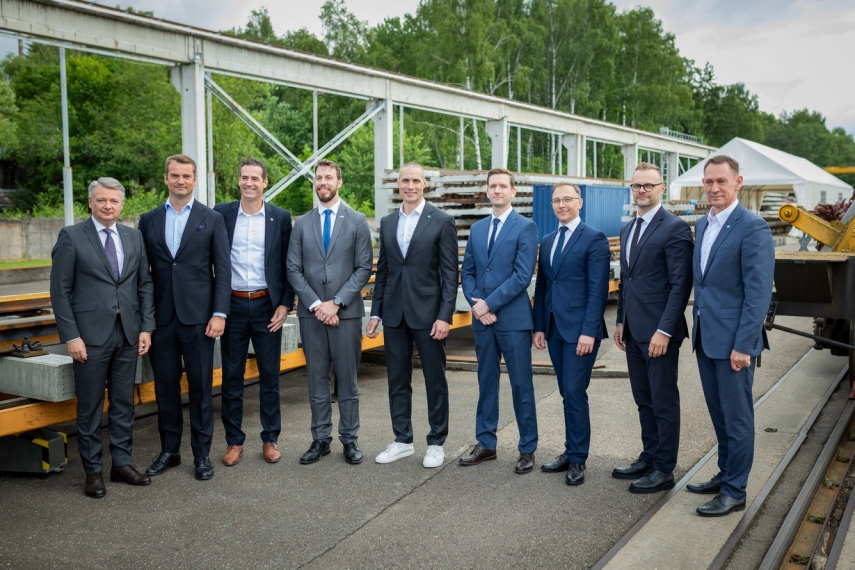
Photo: Baltica and voestalpine Railway Systems mark start of turnout production
Rail Baltica today marked the symbolic start of turnout production for the project at the voestalpine Railway Systems facility in Valčiūnai, Lithuania. The event brought together representatives of the Lithuanian Ministry of Transport and Communications, LTG Group, RB Rail AS, Rail Baltic Estonia and voestalpine Railway Systems to mark the launch of production of a key railway infrastructure component.
The framework agreements for the consolidated supply of turnout systems and rail expansion joints have been signed by the Rail Baltica national implementers in Estonia (Rail Baltic Estonia), Latvia (Eiropas Dzelzceļa līnijas) and Lithuania (LTG Infra) together with RB Rail AS covering components required for the long-term operation of the railway subject to request and financing availability.
“The construction of the European-gauge railway in Lithuania has reached an important milestone – the first tracks have already been laid, and modern high-speed turnout systems will soon be installed on the most advanced Rail Baltica section near Jonava. Notably, this infrastructure will be produced here in Lithuania, marking a substantial investment in regional security and in faster, more convenient connections with Europe,” said Roderikas Žiobakas, Deputy Minister of Transport and Communications of Lithuania.
“Turnouts are often described as the heart of a railway network,” said Marko Kivila, CEO of RB Rail AS. “By securing a standardized turnout solution for Rail Baltica, we are helping to create the conditions for safe and efficient railway operations across the corridor.”
“We are proud that turnout production for Rail Baltica is starting here in Lithuania, with the first turnouts to be delivered already this autumn for the construction of the railway superstructure,” said Arūnas Rumskas, Acting CEO of LTG Group. “Our collaboration with voestalpine Railway Systems is a strong example of how an international project can create tangible value in the region. Investments made into Rail Baltica not only support the development of modern infrastructure, but also return to local economies through jobs, partnerships and business opportunities, while contributing to broader economic benefits across Europe.”
Turnouts create the network
Turnouts allow trains to move between tracks and provide access to stations, terminals and maintenance facilities. While rails and sleepers form the track, turnouts enable network connectivity. For a high-speed railway such as Rail Baltica, they are among the more technically demanding elements of the system and must meet strict requirements for safety, performance and reliability.
The consolidated supply approach provides a common turnout solution across the corridor, supporting interoperability between infrastructure, signalling and control systems while simplifying maintenance and reducing lifecycle complexity. Working with a single supplier also allows turnout design to be coordinated with wider railway design activities, including track alignment, civil structures, electrification and signalling, while providing visibility on production capacity and delivery schedules as construction progresses.
Rail expansion joints, also covered by the agreements, accommodate rail movement caused by temperature changes and structural shifts, helping to maintain safe and continuous railway operations over time.
A strategic international partner
voestalpine, global market leader in railway systems, has extensive experience delivering turnout systems and rail expansion joints for railway projects internationally and has an established presence in the Baltic region.
“We are pleased to welcome voestalpine as a partner for this important phase of the project,” added Kivila. “Their experience and regional presence will support the delivery of these critical systems.”
The start of turnout production for Rail Baltica in Lithuania marks an important milestone for voestalpine Railway Systems. The company looks forward to delivering an integrated solution for the railway corridor.
The agreements establish a common technical solution for turnout systems and rail expansion joints across the corridor and provide a framework for supplying these components in line with construction needs throughout the project.
About Rail Baltica
Rail Baltica is one of the largest high-speed rail projects in Europe and is part of the Trans-European Transport Network. It aims to improve connectivity, strengthen regional security and support economic growth in the Baltic states. The new railway will link Estonia, Latvia and Lithuania with Poland and, indirectly, with Finland, as well as with the broader European rail network.
Rail Baltica will be fully electrified with a standard gauge of 1435 mm and it will be equipped with ERTMS (European Rail Traffic Management System). It has been designed to meet European standards. With a design speed of 249 km/h, Rail Baltica will reduce travel times between the Baltic states and major European cities by more than half. It will serve as a modern infrastructure for passenger, freight and military mobility, promoting accessibility and facilitating business, tourism and cultural exchange. Rail Baltica will help establish the Baltics as a key link in European trade and cooperation.

Please enter your username and password.

2026 © The Baltic Times /Cookies Policy Privacy Policy