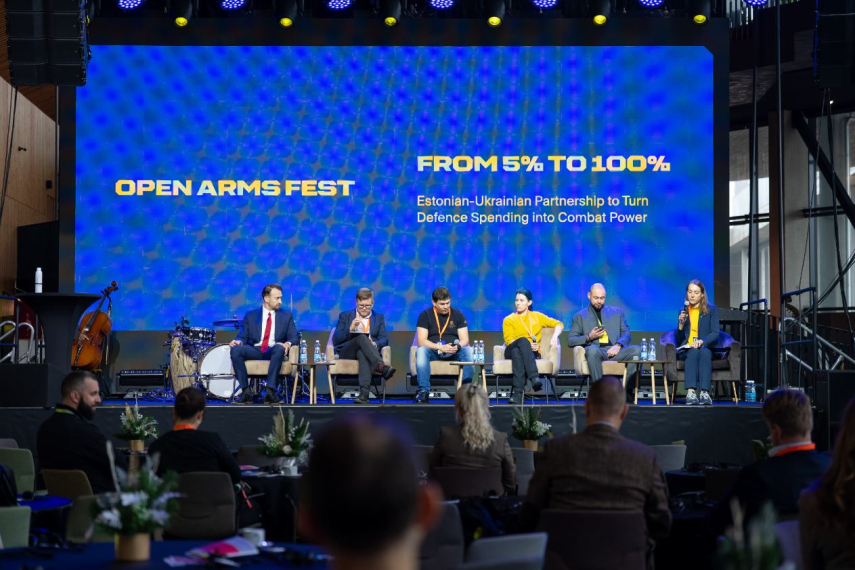
Tallinn, 26 November 2026. Open Arms Fest took place in Tallinn on 19–20 November, bringing together Ukrainian defence industry representatives and Cultural Forces through industry meetings, public discussions, a contemporary art exhibition and live performances as part of a travelling programme across four NATO countries.
The two-day programme aimed to strengthen cooperation between Ukraine and Estonia by bringing Ukraine’s defence technology, wartime experience, culture and people into direct dialogue with Estonian institutions and society. It addressed the potential to scale Ukrainian defence capabilities and share operational experience in support of Europe’s collective security.
“For many of our Ukrainian participants, the subjects we have discussed here are part of their own lives. Your willingness to share these experiences deserves our deepest respect. Ukraine has learned, at great cost, how quickly a country under attack must adapt. We are ready to share that experience and put it to work with our partners. This is why Open Arms Fest matters.” – Volodymyr Boiechko, Ambassador Extraordinary and Plenipotentiary of Ukraine to the Republic of Estonia
“Today, at the same venue, defence technologies stand side by side with Ukrainian culture. Weapons make sense only when they protect people’s lives, freedom and values. Over the years of full-scale war, Ukraine’s defence industry has become one of the most dynamic in the world. Our companies develop, test and improve solutions not on test ranges, but at the front. And they do it in weeks, not years.
But no country fights alone. Europe has capital, production capacity, a technology base and standards. Ukraine has combat experience, speed and people who know what works today and what will work tomorrow.
That is why cooperation with the European defence industry is a matter of security for us. We are open to joint production, joint ventures, investment in production in Ukraine and in your countries, joint development and sharing battlefield experience.
Every joint venture and every new production line strengthens deterrence of the aggressor not only for Ukraine, but also for the Nordics and the Baltics. I’ll say a word about a dimension of war that cannot be seen on a map. Russia fights not just with missiles and drones, but for people’s minds. It strikes at trust in institutions, at the unity of societies, at their readiness to defend themselves.
So it is important to build our resilience in the cognitive domain and counter hostile influence. After all, your societies are targets of the same influence operations” – Yevhenii Khmara, Minister of Defence of Ukraine.
Defence cooperation and industrial capacity
Ukraine’s defence sector was represented by Victory Drones, Victory Neurones, Ukrainian Autonomous Systems, PG Robotics, FlyHub, Gurzuf Defence, TENCORE and others. Company representatives presented their work through multimedia stands and direct conversations about technology development, production capacity and potential cooperation with Finland’s defence sector.
The closed industry programme focused on operational lessons from the battlefield, technology integration and bottlenecks in supply chains, certification and procurement. The Ukrainian company pitches and meets with Estonian manufacturers, investors and government representatives to provide a forum to discuss production capacity and potential B2B and B2G cooperation.
“Wars are won by those who think, develop and scale technologies faster. Ukraine is the only country in Europe with technologies tested in real war. We have the world’s fastest practical innovation cycle, and our military personnel and weapons manufacturers understand how modern warfare works.
“We share our experience with our allies to help keep you safe and so that, finally united, we can defeat Russia. Ukraine has proven that Putin’s power exists only in the minds of Western leaders.” – Mariia Berlinska, founder of Victory Drones and Ukrainian defence technology expert.
Cognitive defence and shared security
Cognitive defence formed part of the programme through discussions on societal resilience, hybrid warfare and disinformation. The focus included the relevance of Ukraine’s wartime experience for Estonia and other Northern European countries, and how defence and public education can help societies recognise and respond to hostile influence.
Culture and the society being defended
The festival connects Ukraine’s cultural life with the experiences of those defending it. The idea is not that culture should become militarised. It is the opposite: the ability to defend a society matters because there is a society worth defending.
The public programme on 19–20 November brought this idea into focus through work by Ukrainian artists, writers and musicians, which presented a cultural scene that has continued to change and create throughout the war.
The exhibition explored war, memory and Ukrainian identity through paintings, graphic works and art objects by Ukrainian artists serving in the Armed Forces. Through irony, symbolism and references to Ukrainian traditions, the works placed military imagery alongside flowers, mythical figures and scenes of everyday life, reflecting the coexistence of creativity and combat experience in contemporary Ukraine.
Discussions covered Ukraine’s historical and contemporary connections with the Nordic countries, hybrid warfare, the information environment and the struggle over perceptions of reality. Participants included Vakhtang Kipiani, Vakhtang Kebuladze, Oleksandr Komarov, Yuliia “Taira” Paievska, Khuan Alberto Leiva García, Alina Sarnatska, Ihor Mitrov and Yevhen Ovcharov.
“You must be prepared for any scenario.
I believe we will overcome Russia’s onslaught with your help and the help of the free world. But we must remember that the world cannot be considered safe and friendly as long as aggressive authoritarian regimes such as Russia exist.
You need to review your standards for unforeseen situations, whether military or technological.
The surest way is to help Ukraine, for which I am immensely grateful. Then our experience and skills will be of use to you, whatever happens.
And again, thank you.” – Yuliia “Taira” Paievska, Ukrainian servicewoman, paramedic and former prisoner of war.
“Open Arms Fest explored the defence of Ukraine and the broader European civilisation to which it belongs, while also showing what we are defending. The Ukrainian cultural programme, presented by the Cultural Forces of Ukraine, featured philosophical discussions, musical performances, a painting exhibition and a literary stand showcasing writers serving in the armed forces. Together, these demonstrated that, even amid unprecedented existential trials, Ukrainian culture is a source of new meaning and new ontological knowledge for Europe.” – Senior soldier Oleksandr Zakletskyi, Cultural Forces of Ukraine.
The music programme featured Dakh Daughters, Ivan Tkalenko, ZIFERBLAT, NAZVA, the Vasyl Slipak Ensemble and Orchestra 59. The Vasyl Slipak Ensemble brings together professional singers and conductors who joined Ukraine’s Defence Forces during the full-scale invasion. Orchestra 59 grew out of the orchestra of the 59th Brigade, while Tkalenko’s work explores the bandura, including an electric instrument he developed himself.
Tallinn marked the final stop of the travelling programme, following earlier events in Oslo, Stockholm and Helsinki. Each city’s programme was adapted to local audiences, partners and cultural context, bringing Ukrainian experience into dialogue with countries that share responsibility for Europe’s security.
OPEN TO LIFE. READY TO DEFEND IT.

Please enter your username and password.

2026 © The Baltic Times /Cookies Policy Privacy Policy