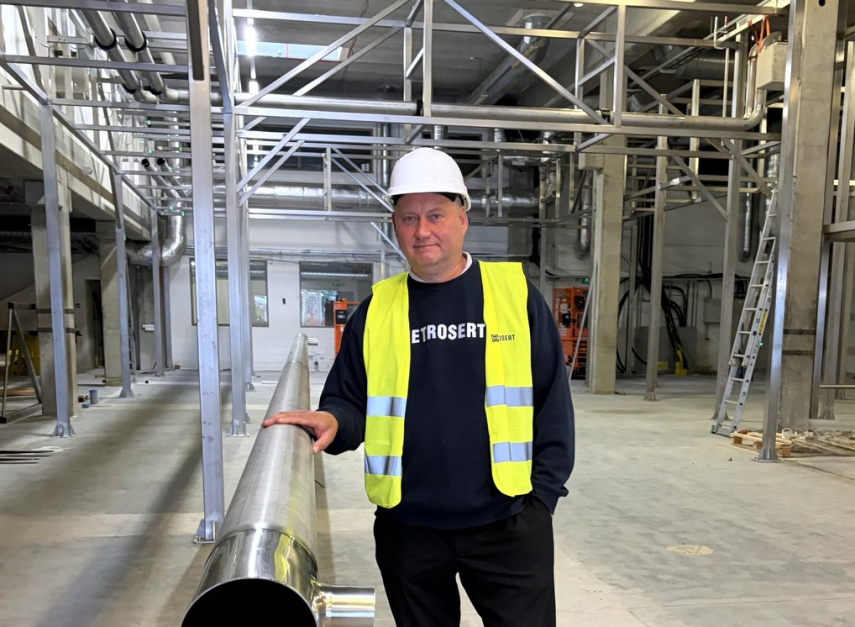
Estonia’s Applied Research Centre and national metrology institute Metrosert has signed a contract worth nearly EUR 2 million with construction company Savekate OÜ to establish a unique synthetic biology pilot plant in Estonia. The new facility will provide biotechnology companies with a long-awaited opportunity to test and develop new production processes before making substantial investments in industrial-scale production.
The pilot plant will serve both Estonian as well as international companies developing new products and ingredients from biological and renewable feedstocks. It will enable the production of proteins, enzymes, yeasts, plant-based fats and other bio-based substances used in food, materials, chemicals and pharmaceuticals to be developed and tested at a larger scale. Such technologies can help replace fossil-based raw materials while making production more resource-efficient and environmentally sustainable.
According to Kaupo Reede, Head of Biorefining Unit at Metrosert’s Applied Research Centre, the pilot plant will provide Estonian biotechnology companies with a previously unavailable opportunity to progress from laboratory trials to production-ready solutions.
“Synthetic biology is no longer a technology of the distant future, but a practical tool for building a new-generation economy. Estonia has a considerable number of entrepreneurs and researchers with strong ideas and promising initial laboratory results. To advance to the next stage, however, they need an environment in which technologies can be tested at a larger scale,” Reede said.
According to Kaupo Reede, the absence of such a pilot facility has been a major bottleneck across the whole the region, preventing many biotechnology companies from successfully bringing their products into production.
“Biotechnology is a capital-intensive and highly regulated field. Before industrial-scale production can begin, the process must be proven to work, its reliability must be assessed, and initial batches must be produced for prospective customers and partners to test. In most cases, it is neither feasible nor sensible for a company to build its own intermediate-scale facility for this purpose. The shared pilot infrastructure provided by Metrosert will help reduce development risks and bring solutions into actual production more quickly,” Reede explained.
“The contract signed with Savekate OÜ is an important step towards ensuring that the ideas of Estonian entrepreneurs and researchers do not remain within laboratory walls but can reach production readiness in an environment that complies with international requirements. The pilot plant will serve as a bridge between science and commercial application,” he added.
At the new pilot plant, companies will be able to develop their production processes, gradually scale up production volumes and manufacture their first larger product batches. Metrosert will also support companies in planning their development pathways, establishing international collaborative projects, and engaging partners and prospective customers.
As the facility will also be used to develop and test solutions intended for the food industry and novel foods, it will be built to comply with stringent international food safety requirements. This will enable companies to develop processes and produce prototypes in an environment that supports their further progression towards industrial-scale production and international markets.
Construction of Metrosert’s synthetic biology pilot plant will begin shortly, and the facility is expected to be completed by the end of 2026.
About Metrosert
AS Metrosert is Estonia’s national applied research centre and national metrology institute. The state-owned company employs approximately 140 specialists and supports sustainable economic growth through applied research, measurement and quality systems, as well as cooperation between industry and research institutions. The Applied Research Centre focuses on five areas: drone technologies, autonomous vehicles, hydrogen technologies, biorefining and health data.

Please enter your username and password.

2026 © The Baltic Times /Cookies Policy Privacy Policy