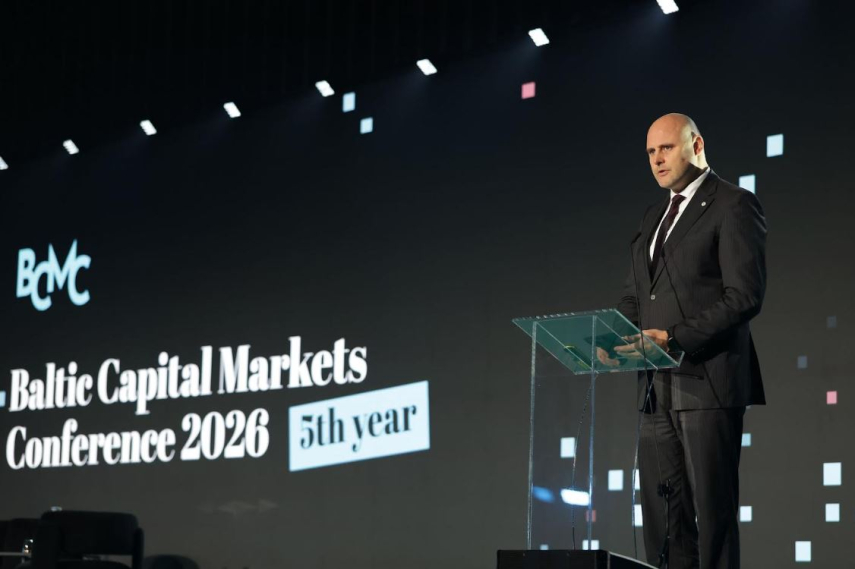
RIGA - Prime Minister Andris Kulbergs (United List) aims not to simply fill vacancies, but to create a more flexible and inclusive labor market where everyone who wants to and is able to work will have the opportunity to do so, the prime minister told LETA while commenting on the government's plan to increase the number of employed people in Latvia by 26,000 until 2030.
The potential for 26,000 new employees is based not only on attracting new workers, but also on how well Latvia is able to integrate into the labor market those who, for various reasons, are currently not working or are working less than they would like.
"It is important for Latvia to create more job opportunities for those who have so far remained outside the labor market or have been unable to participate in it fully," Kulbergs emphasized.
According to Kulbergs, ideas on how to encourage people to participate more actively in the economy have emerged from analyzing the situation on Latvia's labor market, discussing the matter with social partners, and studying the experiences of other countries. "By analyzing why some people are not working or are working only part-time, we have identified several groups whose participation in the labor market has significant potential," said the prime minister, though he did not specify exactly who carried out the analysis.
One of these groups is young mothers and fathers who are on parental leave. "We see that some parents would like to return to the labor market gradually, for example, by working part-time while continuing to care for their child," said Kulbergs.
However, current regulations and the conditions for receiving parental leave benefits may not encourage such a choice. Therefore, one of the approaches, according to the prime minister, is to seek solutions that would allow parents to more flexibly combine child care with employment, without losing financial support.
Another group is made up of young people who are neither working nor studying but, for example, live with their parents or grandparents. Kulbergs believes that it is important to understand what is preventing them from entering the labor market and how to help them take their first steps toward a working life and independence.
The third area is harnessing the potential of the "silver economy". Kulbergs explains that this refers to people who have reached retirement age but still want to and are able to work.
"We need to find ways to motivate them to remain in the labor market, as well as create additional incentives for employers to value and utilize these individuals' experience," says Kulbergs. It is important for employees of different generations on the labor market to complement one another, rather than being pitted against each other as competitors.
The overall situation on the labor market must also be taken into account, said Kulbergs. Latvia's unemployment rate currently stands at 6.7 percent, one of the lowest figures in recent years. According to Kulbergs, this means that additional workers cannot be found solely among those who are currently unemployed.
"We need to look more broadly and seek opportunities to involve people who, for various reasons, have not been active on the labor market until now," says Kulbergs.
The next step, according to Kulbergs, is to evaluate specific solutions and feasibility of implementing them, namely, how to improve the legal framework and incentive mechanisms so that it is easier for people to enter the labor market, while giving employers the opportunity to attract and retain employees.
As reported, the prime minister aims to increase the number of workers to 909,000 by 2030. That would be 26,000 more workers than in 2025. Kulbergs stated that if 909,000 people were working in Latvia, the state would receive approximately EUR 290 million more in taxes each year.
The prime minister noted that these people could be found among the approximately 28,000 young people who are neither working nor studying. They could be encouraged to work by allowing them to earn income at a reduced personal income tax rate during their first three years of employment. Similarly, potential employees could be found among the approximately 15,000 new mothers on maternity leave. Kulbergs suggests that they could be allowed to work part-time without losing their parental benefits.
Meanwhile, seniors could be encouraged to enter the labor market by offering lower employer social security contributions and flexible work schedules. Kulbergs also highlighted 3,000-6,000 public-sector employees who could transition to the private sector as a resource for filling these jobs.

Please enter your username and password.


2026 © The Baltic Times /Cookies Policy Privacy Policy