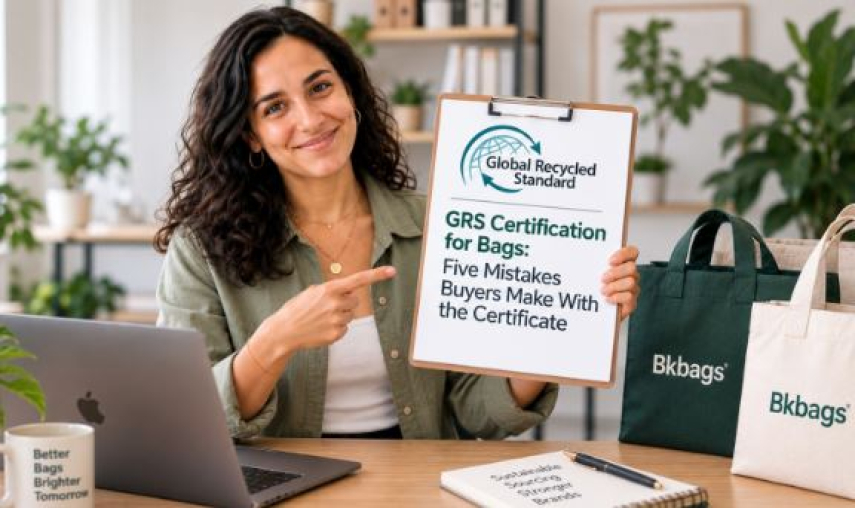
The GRS certificate a supplier sends with a quotation for recycled bags is a scope certificate, because a transaction certificate cannot exist until the goods ship. A scope certificate cannot prove that the order contains a single gram of recycled material.
The Global Recycled Standard (GRS) is a voluntary, third-party verified standard owned by Textile Exchange. It certifies products with at least 20% recycled content and tracks that content through a certified chain of custody, from the recycler to the final business-to-business seller. It also sets social, environmental and chemical requirements for the sites that process the material. For retail buyers of reusable shopping bags, GRS is a check on recycled content they can verify themselves, and in Europe that check matters more from 27 September 2026, when the EU's new rules on environmental claims and sustainability labels apply.
"GRS is four audits wearing one badge," says Simmy Lin, Managing Director of Bk-bags, a Ho Chi Minh City based supplier of reusable shopping bags. "Recycled content, chain of custody, labour, chemicals. Most buyers only ask about the first one, and then they are surprised when their own compliance team asks about the other three."
Mistake 1: Treating the GRS scope certificate as a transaction certificate
GRS certification uses two documents: a scope certificate for the company and a transaction certificate for each shipment.
The scope certificate is issued to a company after an audit. It lists the certified legal entity, its sites, the standard and version, the product categories, the process categories, the materials it may handle, and a validity date. It proves the company is inside a certified chain of custody.
The transaction certificate (TC) is issued for certified goods shipped from one certified seller to one buyer. It names the products, the quantities, the buyer and the certified weight, with pre-consumer and post-consumer content recorded separately. It is the only GRS document that relates to your goods.

A GRS scope certificate says the supplier is in the certified chain. A GRS transaction certificate says your order was.
Bk-bags' full GRS certification guide reads a scope certificate field by field and lists twenty questions to send a supplier, in English, Spanish and Japanese.
Mistake 2: Asking for the transaction certificate too late
A transaction certificate does not arrive automatically. The seller applies to its certification body, and if the seller never applies, no certificate exists.
There is also a deadline. Under Textile Exchange's older certificate policy, which certification bodies can use until 1 April 2027, the certification body must issue a TC if a complete application arrives within 90 calendar days of the earliest shipment date, and may issue one up to 180 days. Under the new policy, which certification bodies may use from 1 October 2026, the "must" window is 180 days. Under both, the certification body may still issue a TC up to 365 days after the earliest shipment date when every product on it is a final product, such as a bag. That is the certification body's discretion, not the buyer's right. Once a complete application is received, the certification body has 14 calendar days to issue it.
Write the transaction certificate into the purchase order as a condition, together with a seller's scope certificate that is valid on the shipment date.
Mistake 3: Trusting the PDF instead of verifying the GRS certificate
A PDF is a file, and files can be edited. You can verify a GRS certificate yourself, without asking the supplier for anything.
1. Scope certificates: search the company name or its Textile Exchange ID on Textile Exchange's Find a Certified Company database, which Textile Exchange describes as the official source for authenticating scope certificates.
2. Transaction certificates: use Textile Exchange's Authenticate a Transaction page, which Textile Exchange names as the only official source for transaction certificates. Treat the URL or QR code printed on the certificate as a pointer, not as the check.
3. While you are there, check four things: the certificate is valid today, the certified organization matches the company on your invoice, your material is on the materials list, and the site and process categories match what you were told.
4. If anything does not reconcile, contact the certification body named on the certificate.
"Any supplier who is unhappy about you verifying their certificate has told you something useful," Lin says. "It takes five minutes and the database is public."
Mistake 4: Asking for GRS on virgin material instead of recycled PP or rPET
GRS certifies recycled content. There is no GRS route for virgin material. A quotation for "GRS certified virgin PP" bags is either a misunderstanding or a fabrication.
For reusable bags, the recycled materials most often certified to GRS are recycled polyester and rPET, recycled polypropylene, including recycled PP woven and non-woven fabric, and recycled cotton. The test is whether the material is named on the supplier's certificate. Bk-bags' own scope certificate, for example, names recycled post-consumer and pre-consumer polypropylene, polyester, polyethylene, PET and polystyrene.
GRS is not a quality standard. The standard says so in its own text. A GRS bag can still have weak handles or a print that cracks. Quality is your specification and your inspection.
GRS and RCS are different. The Recycled Claim Standard (RCS) tracks recycled content from 5% but has no social, environmental or chemical criteria. If the certificate says RCS and the sales deck says GRS, ask why.
Mistake 5: Printing a GRS claim the certificate does not support
- 20% recycled content makes a GRS product.
- 50% recycled content is the minimum for the GRS label on a consumer-facing product.
- Certification up to the brand. Under Textile Exchange's Standards Claims Policy (TE-301 V1.4), an on-product GRS claim on a final product sold to consumers requires certification up to the brand, and the certification body must approve the claim before it is used. A retailer whose own brand is on the bag needs its own GRS certification to put a GRS product claim or the GRS logo on it.
- Without that certification, a brand can still make its own specific claim, such as "made with 60% recycled polypropylene by weight", backed by the transaction certificate and without the GRS name or logo.
Regulation now sits on top of Textile Exchange's rules. Directive (EU) 2024/825 applies from 27 September 2026 and bans generic claims such as "eco-friendly" unless the trader can demonstrate recognised excellent environmental performance relevant to the claim. In the US, the FTC Green Guides (16 CFR 260.13) say that when a product is only partly made of recycled material, the claim should state the recycled share by weight.
"The safest sentence is the boring one," Lin says. "Say the material, say the percentage, say which certificate it sits on. Adjectives are what regulators read twice."
GRS is changing, but not for 2026 orders
Textile Exchange published GRS 5.0 in July 2026, and GRS itself is being replaced by the Materials Matter Standard, effective 31 December 2026 and mandatory from 31 December 2027. Existing GRS certificates stay valid until their own expiry date. For an order placed in 2026 or 2027, the checks above still apply.
A checklist for ordering GRS certified bags
1. Ask whether the document you received is a scope certificate or a transaction certificate.
2. Verify the scope certificate on Textile Exchange's Find a Certified Company database.
3. Check that the certificate will still be valid on your shipment date.
4. Confirm your material is on the certificate's materials list, and that it is a recycled grade.
5. Write the transaction certificate into the purchase order as a condition.
6. Ask what recycled percentage the TC will show, split into pre-consumer and post-consumer content.
7. Agree the exact wording on the bag, and who is certified to make it, before artwork is approved.
Read more: Your Guide to Buying a Crossbody Bag
About Bk-bags
Bk-bags is a supplier of reusable shopping bags and packaging to retailers and brands, based in Ho Chi Minh City and supplying since 2006, with production in Vietnam and China. Simmy Lin is the company's Managing Director. Its range of reusable bags covers PP woven, PP non-woven, rPET, cotton and polyester, with a minimum order of 10,000 pieces for PP, cotton and rPET and 5,000 for polyester.
Sources
- Textile Exchange, Global Recycled Standard 4.0 (1 July 2017) and GRS 5.0 (July 2026)
- Textile Exchange, Policy for Scope and Transaction Certificates TE-TXL-POL-203 V4.0 (published 1 April 2026, effective 1 October 2026, mandatory 1 April 2027) and ASR-104 V3.1 (older policy)
- Textile Exchange, Standards Claims Policy TE-301 V1.4 (8 October 2025), clause B3.1.2
- Textile Exchange, Recycled Claim Standard 2.0
- Textile Exchange, Materials Matter Standard (final criteria published 12 December 2025)
- Directive (EU) 2024/825, Annex I
- Textile Exchange, Find a Certified Company and Authenticate a Transaction
- US FTC Green Guides, 16 CFR 260.13

Please enter your username and password.


2026 © The Baltic Times /Cookies Policy Privacy Policy