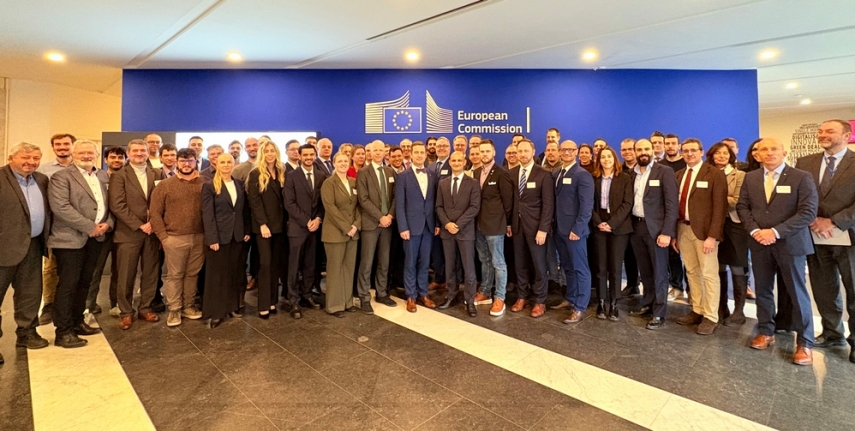
The major integrated unmanned ground platform project iMUGS2 of the European Defence Fund (EDF – European Defence Fund) was officially launched in Brussels. The goal of iMUGS2 (Integrated Modular Unmanned Ground Systems) is to strengthen Europe’s autonomy and robotics capabilities by creating a secure and interoperable architecture for both unmanned and manned ground platforms.
According to Kuno Peek, Head of EU Defence Projects at the Estonian Centre for Defence Investments (ECDI), the project supports Europe’s technological independence in key defence areas – from AI-based autonomy to system integration as well as communication, command, and control solutions.
Estonia has a central role in the project: the Estonian Centre for Defence Investments (ECDI) coordinates the interests of member states, while the consortium coordinator is the Estonian company Milrem Robotics. Other Estonian companies participating as project partners include Cybernetica and Talgen Cybersecurity (Nortal).
Raul Rikk, Director of Capability Development at Milrem Robotics, emphasized that iMUGS2 takes Europe a major step forward towards interoperable and scalable robotic forces – for example, a future European unmanned battalion. According to him, the project fosters innovation and international cooperation and lays the groundwork for AI-based autonomous systems to operate seamlessly together on the battlefield.
The strong position of Estonian companies in European defence innovation is also evident in the European Defence Fund’s calls for proposals. Through the 2024 work programme, 62 projects are funded, with Estonian companies participating in 15 consortia.
“Applications for the 2025 work programme also show the activity of Estonia’s defence industry – our companies are involved in 49 international consortia, with results to be announced in spring 2026,” said Peek.
The iMUGS2 consortium brings together Europe’s leading defence, research, and technology organisations, with a total volume of approximately 55 million euros, 50 million of which is covered by the European Commission’s grant. Estonia’s contribution is 461,000 euros, making it the third-largest national contributor.

Please enter your username and password.

2026 © The Baltic Times /Cookies Policy Privacy Policy