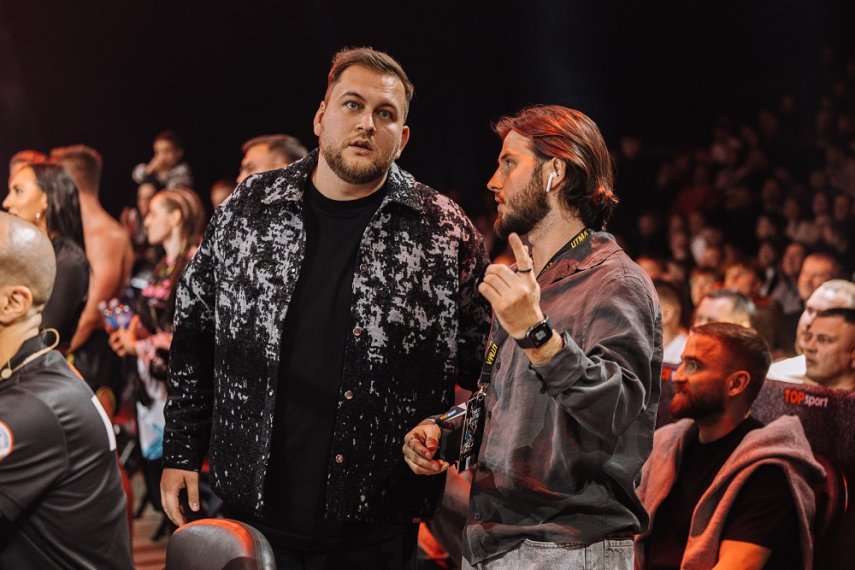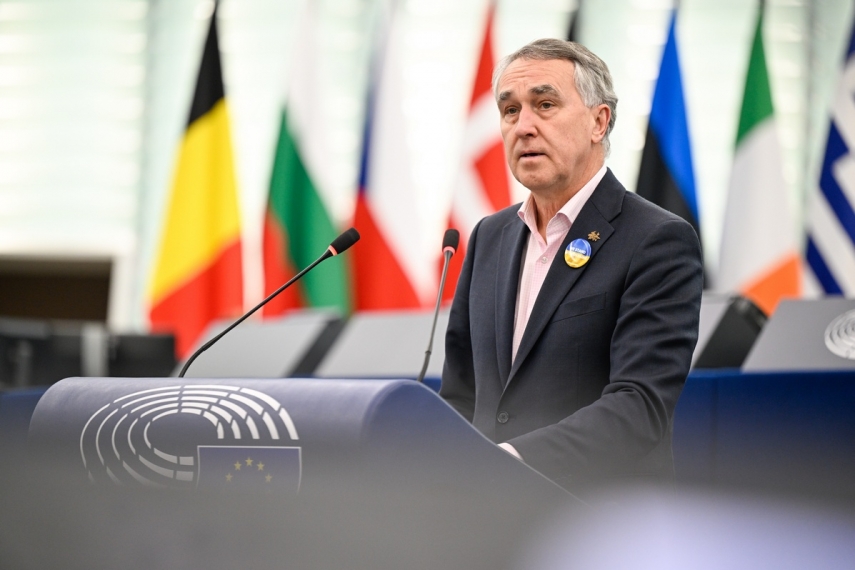
Photo: Lithuanian Liberal MEP Petras Austrevicius, representing the Renew Europe Group in the EP
Despite the numerous challenges the European Union is facing, Lithuanian Liberal MEP Petras Austrevicius, who represents the Renew Europe group in the European Parliament for the 2024–2029 term and serves as a member of the Committee on Foreign Affairs, the Committee on Security and Defence, and the Subcommittee on Human Rights, remains optimistic about the future of the bloc, which is being eyed by another 10 countries – most of them in the Balkans. “Decisions still need to be made regarding EU expansion. It is, however, obvious now that the new member states’ memberships will be different from those of the older member states – with a transition period toward full membership,” the MEP told The Baltic Times Magazine.
I’ve headed to this interview with you from the Brussels Economic Forum 2026, whose theme this year is Artificial Intelligence, which is also on the agenda of the European Parliament. Where do you believe AI is headed in the bloc? Must the member states race to embrace it – fully, like the US or China, or only partially?
I firmly believe that artificial intelligence must serve us – people – and not vice versa. In some fields, such as medicine, where the human body consists of billions of cells and identifying the cause of an illness is not always clear even to doctors, the applicability and use of AI seem boundless, helping to treat and prevent many diseases.
I stand by the position of the European Parliament: while supporting AI and investing heavily in it, at the same time we must regulate it so that, to use medical terminology, we prevent the virus from spreading out of control. AI can be used not only for benevolent purposes – be it medicine, reducing administrative burdens, science or any other field – but also for destructive ones. Alas.
The European Parliament’s Committee on Foreign Affairs recently debated the preparedness of Albania and Montenegro for EU membership. Could you comment on the progress these countries – as well as other EU aspirants – have made on their path toward accession?
In fact, there are currently 10 countries seeking EU membership. I would divide them into three clear groups: Turkey and Sakartvelo have drifted away from the clearly defined roadmap toward membership.
For the former, the process is taking too long and has been marked by undemocratic developments in Ankara. In Tbilisi, we also see a shift away from EU integration – the government has temporarily suspended EU accession talks.
Then there are several Western Balkan EU aspirants where the EU sees too little progress – or no progress at all – on the path toward membership. Specifically, Bosnia and Herzegovina, for example – as rapporteur on EU enlargement, I contributed to the recent report on its progress – has a longer list of unfinished tasks than completed ones when it comes to meeting EU membership requirements and commitments.
Bosnia is encouraged to move faster on judiciary reform, anti-corruption measures, electoral reform, and state functionality.
I believe that EU enlargement should remain based on concrete reforms and democratic standards rather than geopolitics alone.
And then, in the third group, we have countries like Ukraine, Moldova, Albania, North Macedonia and Montenegro that are moving forward toward EU membership earnestly, purposefully and while fulfilling their obligations.
At the highest EU level, we still need to agree on a clear mechanism for accepting new member states, as the old model of EU enlargement is becoming increasingly difficult – or even impossible – due to referendum requirements embedded in the legislation of some member states, where domestic political considerations often outweigh broader EU interests.
The emerging proposal of “reverse EU membership”, a political concept referring to the idea that candidate countries could receive some benefits of EU integration before becoming full members – while full voting rights and full access to EU institutions would come later – has been rejected by some EU member states.
For us in the Baltic States, Ukraine’s future EU membership is seen as a key guarantor of regional stability and security. Do you believe Ukraine could join the EU before 2030, a goal strongly supported by Lithuania?
EU member states have not set a concrete date for Ukraine’s accession to the EU, as there is still no clear understanding of how membership could proceed while the country remains at war.
The proposal currently gaining the most support is for Ukraine to first join various sectoral EU frameworks – including defence, foreign policy, energy and agriculture – before being granted broader EU membership rights.
There is little doubt that Ukraine’s EU membership is essential for the future architecture of European defence.
I believe Ukraine could join the EU within the next two to four years, although Ukraine has stated that it plans to fulfil all EU accession obligations by the end of 2027.
This year’s annual Venice Biennale faced backlash following the decision to allow Russia to participate. At the same time, we are hearing more Western politicians – including Estonian President Alar Karis – hinting at the need for engagement with Russia and suggesting that territorial concessions by Ukraine may ultimately be unavoidable. Are you concerned that Russia, the aggressor in this war, is gradually being brought back onto the international stage?
Indeed, there have been certain attempts in that direction – though not at the EU level. Perhaps we should not be overly surprised by this, considering the emergence of new political parties and politicians, as well as the growing influence of radical forces in some countries.
For example, last week (the interview took place on May 13), one Member of the European Parliament, representing Luxembourg, called on people to attend an economic forum in Saint Petersburg, Russia, arguing that there is an alleged need to restart dialogue with Russia, and so on.
I remain convinced that the EU should rule out any normalization of ties with Russia unless and until an agreement with Ukraine is reached. We must acknowledge a fundamental reality: Russia remains an imperial power driven by imperial ambitions – it has always been so. And, frankly, it is likely to remain so even after any agreement with Ukraine is signed.
That said, I was genuinely surprised by the reasoning expressed by Estonian president Alar Karis. I am not sure what prompted him to make such remarks.
The Baltic States have been rattled by a series of foreign drone crashes – incidents in which Russia’s involvement cannot be ruled out. In March, such cases were recorded in Lithuania and Estonia, and in May – in Latvia. What would need to happen for NATO to take a stronger and more explicit position on the situation? And has the idea of creating a European drone wall made any tangible progress?
I hope the situation is being closely monitored and that what currently appear to be isolated incidents will not evolve into a major threat requiring consultations under NATO’s Article 5.
I see these incidents as part of a broader picture – namely, Russia’s increasingly intense campaign of cyber and hybrid warfare against the European Union. Under no circumstances should we downplay Ukraine’s warnings to the EU about Russia’s preparedness for a potential military confrontation with NATO.
Despite the stalled warfare in Ukraine, Russia is reportedly continuing to build new infrastructure, including roads and military-related facilities, along its borders with EU and NATO member states.
As of today, honestly speaking, neither the EU nor NATO leadership has fully acknowledged or adequately responded to Russia’s belligerent behaviour, including repeated drone incursions.
So far, I do not see what could effectively prevent Russia or Belarus from carrying out such attacks. To me, this indicates that we still have not done everything possible to make the two countries fully feel the impact and severity of the sanctions imposed on them.
As long as China remains their largest supplier of weaponry and critically important components, our efforts to constrain Russia and Belarus will remain limited.
Regarding your question about the European drone wall, the idea – also supported by Lithuania’s Andrius Kubilius, the European Union’s first-ever Commissioner for Defence and Space in the second Ursula von der Leyen Commission – appears to have lost momentum. Furthermore, the idea was ultimately scrapped. Sadly.
However, the EU has agreed to ramp up its drone production capacities. I only wish Lithuania’s involvement were greater and backed more strongly by its leadership. Overall, the EU has adopted 11 projects related to strengthening defence capabilities.
Amid reports by respected media outlets that US Secretary of State Marco Rubio has been avoiding sit-down meetings with the EU’s top diplomat Kaja Kallas, how would you describe the current state of transatlantic relations between the United States and the European Union? What concerns you most about the direction these relations are taking?
Indeed, the current state of transatlantic relations can be described as highly inconsistent and uncertain – although the core interests that have always united us remain the same: security, defence, trade and technological advancement.
In Scotland last year, Ursula von der Leyen, the president of the European Commission, and US President Donald Trump agreed on a 15 percent tariff rate on all goods, but today we are seeing quite different developments. The US currently imposes 50 percent tariffs on EU steel and aluminium exports. Quite recently, the US hinted at a 25 percent tax on European cars, and I could go on with similar examples – unfortunately. In such a rapidly changing taxation environment, it is very hard to engage in stable mutual relations.
The US tariff measures are prompting the EU to consider retaliatory steps, which could spill over into broader political decisions as well – including the European Union’s willingness to contribute to resolving the Strait of Hormuz crisis, itself a consequence of the US military campaign against Iran.
Fortunately, when it comes to defence, relations between the US and the EU remain active and functional. The elections in the United States at the end of the year are likely to alter the dynamics of political relations, but the uncertainty we are currently experiencing will not simply disappear.
Are you concerned that radical political forces in Europe, encouraged by President Donald Trump, will continue to gain strength, reshaping or undermining the traditional party-based political landscape across the continent? Where could such developments ultimately lead Europe?
What gives me hope is that the EU has made clear it will not tolerate external attempts – and that from the United States, too – to influence or derail the principles the European Union has long stood for: democracy and the values that come with it.
This also applies to our social media space, where disinformation in many forms continues to flourish – unfortunately, often under the shield of free speech.
I hope that by the next European Parliament elections in 2029, the EU will emerge stronger – both in terms of defence and in the digital sphere, while also building new partnerships around the world, especially with the rapidly rising countries of Southeast Asia.
And, importantly, with a clear strategic plan for at least the next decade or so.


Please enter your username and password.

2026 © The Baltic Times /Cookies Policy Privacy Policy