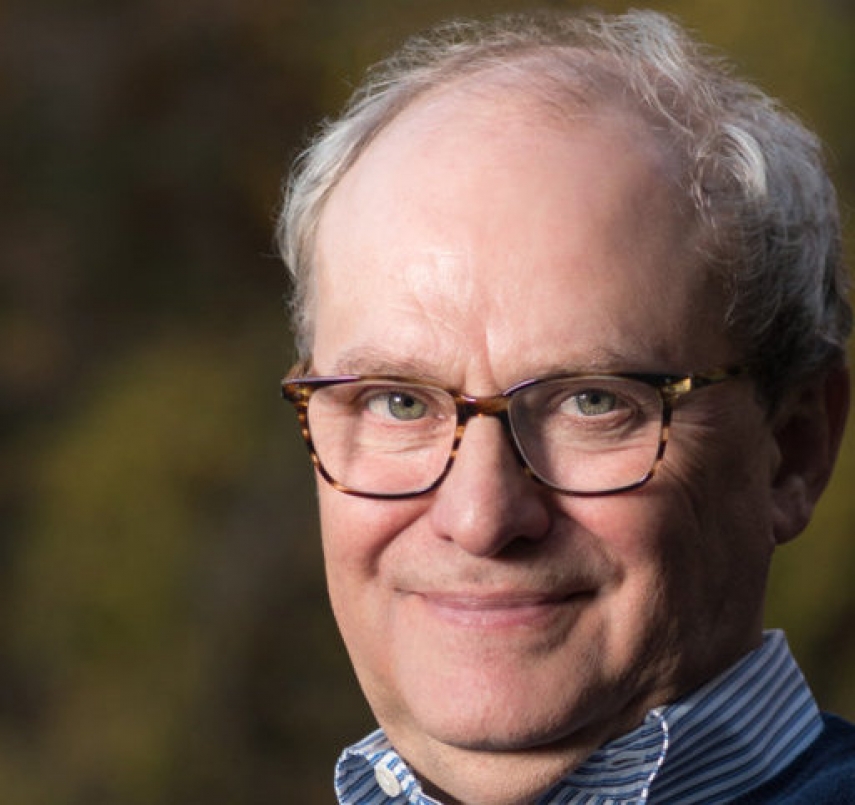
“It’s very sad to see businesses that lack creativity. These are often large, overgrown organisations run by technocrats with no wings, no drive,” says entrepreneur Gediminas Kvietkauskas, who ranks among the 500 wealthiest Lithuanians. A philologist by vocation and an engineer by education, he sees business as a creative project, because where there is no creativity, there is no freedom to advance.
In our interview with Gediminas Kvietkauskas, head of East West Agro, a company that sells agricultural machinery, and a graduate of the Engineering programme at the Agriculture Academy of Vytautas Magnus University (VMU), we discuss his business, inner freedom, and his first encounter with the university, which dates back to infancy.
You are someone who isn't afraid to speak their mind. Where does that courage come from?
As far back as I can remember, I was never very good at following rules. You won't find me where there are boundaries – and that was true at school as well. Actually, opportunism and courage tend to emerge when you don’t have many opportunities. I didn’t have the opportunity to study what I really wanted. Generally, I think a twelfth grader is far too young to know what they want to be. Our system puts far too much pressure on them to decide. No one knows where life will take them, who they will become, or what they will want to do.
I enrolled wherever I was able to get admitted, because I couldn’t afford to pay for my studies. And that probably gave me a certain inner freedom, because I could change my study programme. I studied civil engineering, then Lithuanian philology, and later emigrated abroad. So I was always fighting for my survival, but I had never firmly decided what I wanted to be. And although I grew up within the community of the Agriculture Academy, that's not what led me into the agricultural machinery business – rather, all those experiences accumulated and eventually led to starting a business.
You’ve mentioned before that you built your business out of a sense of inner freedom.
I’ve always had that inner freedom – the feeling that I am accountable to myself, that I am free to make decisions, whether right or wrong, and to choose the right or the wrong path. When you mess up, you have to look for a way out, and in searching for those ways out, you naturally improve. When you come into business organically, say, from a rural background, you don’t know many of the principles. On the one hand, you make mistakes. On the other, you make bold decisions that those who have studied the field would never make, because their training tells them it can’t be done that way.
A young person is foolish, and that is their greatest strength, because they don’t know the consequences. Of course, they can also come unstuck – there’s always a risk. Business is like the wild – you either survive or you don’t. In the end, that freedom, courage, and rule-breaking turns into instinct.
You mentioned that you didn’t get admitted to the study programme you had dreamed of?
I had dreamed of studying journalism, but I knew perfectly well that my scores left me with no chance of being admitted. There was another plan – a bachelor’s degree in Lithuanian philology followed by journalism – but in the end I never actually gave it a try. And I don’t plan to now.
You studied Lithuanian philology. How does that philological streak manifest itself in business?
I would emphasise the word creativity – literature, poetry, books. After all, I write myself and I read a great deal. I often find myself returning to the book Jonathan Livingston Seagull, which I loved as a teenager and must have read dozens of times. It’s a story about people who tried to do something in life, to rise higher, attempting all sorts of acrobatic manoeuvres in business, in their careers, in life – the kind that no one had tried before. The higher you rise and attempt a new manoeuvre, the more you learn and the more you stand out from the other seagulls. And once you try to rise higher, you can no longer return to where those seagulls live. Usually, you end up an outcast among them, just as Jonathan did.
Creativity in business is an immense advantage. It’s very sad to see businesses that lack creativity. These are often large, overgrown organisations run by technocrats with no wings, no drive. I link our business success to the fact that having a philologist as a leader is an absolutely atypical combination, especially in the agricultural sector.
But when you rise that high, do you end up alone?
Yes, but paradoxical things happen – you meet people like yourself, who at some point also tried to do something on their own, and you find yourself in a different circle. But this circle is on another level altogether, one that grows differently and where everyone helps one another grow. Later, this also leads to business mentorship – when you reach the limits of your capabilities, you begin to find students of your own.
Do you have ambitions to rise even higher? Perhaps to become president?
(Laughs) The ambition to seek the crown is a bad ambition. And working in the agricultural sector has taught me not to plan too far ahead, because nature does not follow your plans. Nature will destroy them with one heavy hailstorm or a single severe frost. Planning here is very reactive – you are constantly responding to change.
So what is your ultimate goal?
I’ll share a very nice thought, though I don’t know who said it. If your goal is money, you will most likely fail. Money is a means to move forward, but if money is the only goal, you will never succeed. The goal should always be growth – growth as a person, as a business, as an organisation; and the organisation’s leader should also strive to nurture new leaders. There is no horizon – perhaps the pursuit of that horizon is the goal.
Looking back, do you notice any mistakes?
There are things I am ashamed of, and many other things besides – I’m only human. But I’m not inclined to look back and dwell on things that have already happened. I like to quote Alcoholics Anonymous, who say: “God, grant me the strength to change what I can change and not to waste strength on what I cannot change.” What would be the point of dwelling on it now?
You are taking part in the second season of the TV project Rykliai (Shark Tank). What idea would you fund without hesitation – what do you think is most lacking in life today?
The first season of Rykliai taught me that you shouldn't focus solely on your own sector. My knowledge is sector-specific – in agriculture – and it limits my understanding of the present and the emerging world. A completely different world is approaching. My children’s generation will see very different things, and we will need to invest in completely different areas. Speaking of the future, it has greatly broadened my understanding.
Are your children already thinking about what they would like to do in the future?
Absolutely no pressure. For example, my eldest is 14 and already worries that he still doesn’t know what he wants to do. He’s only 14! Both my wife and I share the same philosophy – absolutely no pressure. He will follow his heart, and we will support him. Perhaps he’ll want to become a teacher? Wonderful. I myself wanted to be a teacher. And I would have been a good one. In a way, I sometimes think that I did become a teacher – just in a different form.
What would you wish for pupils who are already considering where to study?
There is a Latin word, ingenium, meaning intellect, ingenuity and inventiveness. I would wish them the courage to seek their own ingenium – that inner creativity and drive which helps to overcome any challenge, because every new task is an opportunity to discover something not yet experienced and to refine one’s mastery. When it comes to engineering studies, it is precisely the ability to create, to construct and to see the result in the real world that makes this field so inspiring. I hope that for future students this path in engineering will be full of meaningful discoveries and will inspire them just as it inspired me.
You are now a member of the Council at VMU. What meaning do you find in your continued close ties with the university?
The connection was never broken, as I was brought up in the community of the Agriculture Academy. My mother worked there, so I was practically being changed on the dean’s office table (laughs). I was always around and knew everyone who worked there at the time. That was the community I grew up in. Even when I was studying elsewhere, I still lived within that same community and helped to organise exhibitions. When the business came about, we became patrons – we've always been involved with the university in one way or another. My life has always been closely tied to the university. I always try to speak to students and encourage them to look for the seagulls within themselves.
Do you have any free time outside business? What do you do?
I write, although I haven’t written for a few years now and really ought to return to it. Travelling is a natural way to let the mind rest. I have hobbies such as diving and flying. I like sports as well, though that too is on pause at the moment. There are pauses everywhere – it’s just that kind of time right now. Sometimes it doesn’t feel quite right, but you accept that this is what’s needed for the time being.
We also constantly provide support to Ukraine – we act as a logistical base for various aid organisations transporting vehicles. I also enjoy playing chess – now only occasionally with my sons, though in the past I played very intensively, which is also a great advantage in business. A philologist, a creator, and chess – that’s a very dangerous combination.

Please enter your username and password.
2026 © The Baltic Times /Cookies Policy Privacy Policy