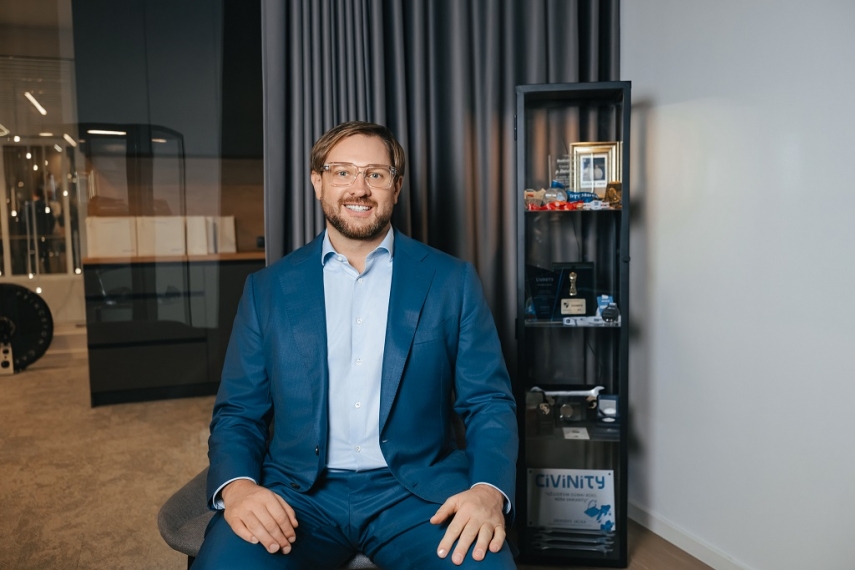
Photo: Deividas Jacka is Founder of Civinity and one of Lithuania’s leading PropTech (property technology) entrepreneurs
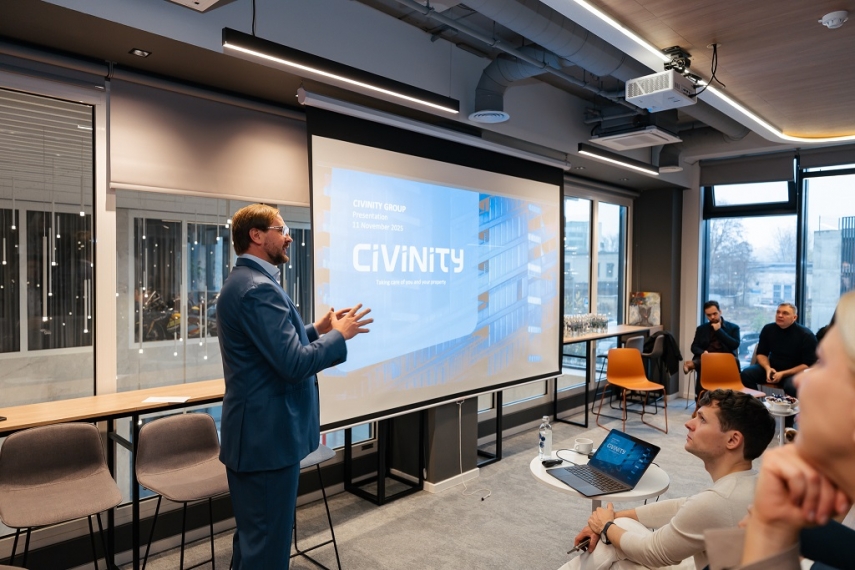
With more than 1,800 employees across Lithuania, Latvia, and the United Kingdom, Civinity is one of the largest building maintenance, engineering, and technology solutions groups in the Baltics. The company is now entering a new growth phase, with ambitions to expand across Europe, digitalise a growing part of its business, and reach €100 million EBITDA within the next five years. To achieve this, Civinity is investing heavily in artificial intelligence, robotics, and digital infrastructure to reshape how people live, work, spend time in buildings, and move between them. The company is also expanding aggressively beyond the Baltics, most recently through acquisitions in Croatia and Slovenia. Deividas Jacka, founder of Civinity and one of the key figures actively investing in and developing the Baltic PropTech (property technology) ecosystem, also agreed to answer The Baltic Times Magazine’s more “futuristic” questions about the future of building management – and Civinity itself.
Future homes will undoubtedly become smarter, more sustainable, more modular and more self-sufficient, with all systems operating together as one integrated ecosystem. You clearly described this in one of your previous interviews with The Baltic Times. But will this really mean greater comfort for people, or simply more control and dependence on systems and housing administrators – including Civinity?
I think the most important principle here is very simple – technology must serve people. While in other areas we can still debate whether technology gives people more control or takes some of it away, in the building sector the answer is fairly clear.
Building technologies are designed so that people do not constantly need to monitor, control and solve complex technical issues themselves.
For example, if a system monitors the condition of a building’s engineering systems in real time and assesses risks, it can respond immediately – for instance, automatically shutting off the water supply the moment a leak is detected. A person would notice such a problem much later.
The same applies to energy consumption, heating and building maintenance. Future buildings will simply operate more intelligently: optimising resources, reducing waste and solving problems before they become visible to residents. People will not need to understand complex systems any more than most of us today need to understand how the internet or electricity grid’s function.
Therefore, both simple and advanced building technologies are being created not to deprive people of control, but to help manage things more efficiently than humans physically could on their own.
Or perhaps by 2100 companies such as Civinity will no longer be needed? Maybe they will be replaced by AI platforms, algorithms and robots?
I believe technology will take over many functions by 2100, but that does not mean organisations such as Civinity will disappear. Rather, their role will fundamentally change.
Buildings are among the most complex infrastructures in cities because they combine many layers – physics, engineering, energy, technology and human behaviour. Even if technologies manage much of the process, organisations will still be needed to integrate all systems into one functioning ecosystem and take responsibility for the outcome.
Most likely, in the future we will speak much less about “administration” in the traditional sense. Instead, urban and building operating systems will emerge, managing energy, mobility, security, maintenance and other processes in real time. Some failures will be resolved before people even notice them, while robots will perform a significant share of physical work.
However, even in such a world, several important questions will remain: who creates and maintains these systems, who guarantees their security, who resolves non-standard situations, who communicates with customers and who takes responsibility when something stops working?
How much does Civinity currently use AI and robotics in its operations?
Digitalisation and artificial intelligence are among Civinity’s strategic priorities. Our goal is to use technologies that help ensure better service quality and improve efficiency.
For example, we recently began cooperating with Nexos.ai, a startup founded by one of the shareholders of NordVPN. This reflects our approach well: we want to work with strong technology-based teams and be part of this transformation.
For several years we have been implementing digital tools and AI solutions. Our engineering teams use advanced technologies in system design, managers use AI to plan work and respond more quickly to customer requests, while cleaning service specialists are increasingly assisted by robotic solutions.
Civinity employs more than 1,600 people across Lithuania, Latvia and the United Kingdom, bringing together more than 30 companies in building maintenance and engineering. What challenges do you face while technologically retraining such a large workforce?
Over the past several years we have devoted significant attention to employee training. Within the group we operate the “Civinity Academy” – a competence development programme involving some of the country’s strongest lecturers.
The academy develops not only professional skills, but also soft skills such as stress management, emotional wellbeing and the ability to adapt to change.
In the future we plan to go further and transform the Civinity Academy into a place where our people can not only improve qualifications in their current field but also retrain in entirely new competencies. I believe this will become especially important in a rapidly changing world.
You have announced highly ambitious expansion plans – with around 15 acquisitions across eight countries currently being considered this year alone, alongside a target of reaching €100 million EBITDA within the next five years. Such multinational expansion across different legal systems must create major management challenges. How will you overcome them?
Over more than 20 years we have learned how to grow – every year new businesses joined the group, which needed not only to be acquired but also successfully integrated. During this time, we experienced both very successful stories and others that taught us valuable lessons.
I always say the most difficult part of acquisitions is not the deal itself, but successful integration.
What works best for us is partial integration – together with the team we agree on direction and goals but leave operational independence in day-to-day activities. We integrate into the group only those areas that create shared value – finance, processes, technologies or access to a broader customer base.
But as acquisitions continue, will employee numbers rise proportionally? Or, through AI and digitalisation, could staff numbers stabilise or even decline?
In our strategy we have set a goal that within five years around 30% of group revenue will come from technology and digital businesses. Such businesses naturally employ fewer people, meaning future workforce growth will no longer be proportional.
AI and automation will likely take over some routine tasks, but demand for new competencies will also increase. The more technologies buildings contain, the more people will be needed who can understand, manage, maintain and integrate them.
So, I do not believe the future of this sector is “people versus technology”. Rather, it will be a partnership between people and technology, where the nature of work itself changes. Some skills will become less important, while others will become far more valuable.
But let us imagine the future: what will an average home look like in 2100? Will everyday problems such as burnt-out stairwell lightbulbs, blocked sewage systems or delayed maintenance become relics of the past because AI and robots will prevent such failures before they occur?
I believe homes in 2100 will resemble living systems far more than today’s buildings. Much of the infrastructure will operate almost invisibly – buildings will monitor their own condition, predict failures and resolve certain problems before people even notice them.
Therefore, issues such as burnt-out lightbulbs, water leaks or blocked sewage systems will certainly become much rarer. Systems will likely identify many such situations in advance, automatically order repairs or even initiate solutions themselves. A large share of technical maintenance and environmental management will probably be performed robotically.
However, I do not think “perfect” buildings where nothing ever breaks will exist. The more technologies we have, the more complex systems themselves will become. Therefore, the challenge of the future will not only be failure prevention, but also the ability to manage extremely complex technological infrastructure and guarantee its security.
And what will a Civinity employee look like in 2100? What qualifications will be essential? When do you expect the turning point where your business becomes driven less by physical labour and more by digital systems and robots?
The profile of a Civinity employee in 2100 will be far more diverse – more people will work on the creation, development and maintenance of technological solutions.
Of course, physical work will not disappear entirely – even in the future someone will still need to physically replace a lightbulb, repair equipment or carry out technical work onsite.
However, the nature of work itself will change dramatically. A large share of routine tasks will be planned, predicted and coordinated using technology, while people will increasingly perform more complex work requiring higher competencies.
As a result, skills in IT, data analysis, automation, cybersecurity and systems integration will become increasingly important. Building maintenance will increasingly resemble technology and infrastructure management.
Could it happen that in the future you will not simply manage buildings, but become a platform controlling entire urban infrastructures, perhaps even highly urbanised city-states?
I believe cities will indeed become far more integrated in the future, and the boundaries between buildings, energy, mobility, security and other urban systems will continue to disappear.
However, that does not mean future cities will be controlled by a single organisation. More likely, we will see ecosystems where different businesses, cities and technology platforms are closely interconnected and cooperate with one another.
I believe the best cities will be those that combine different systems in ways that make urban life more comfortable for people. People do not care how many infrastructures operate behind a city – they care that everything functions smoothly.
What kind of Civinity legacy is most important to you?
Now, what matters most to me is that Civinity grows from one of the largest groups in the Baltics into an international group of companies whose services, products and solutions contribute to transforming cities into smarter, more sustainable places where people enjoy living.

Please enter your username and password.

2026 © The Baltic Times /Cookies Policy Privacy Policy