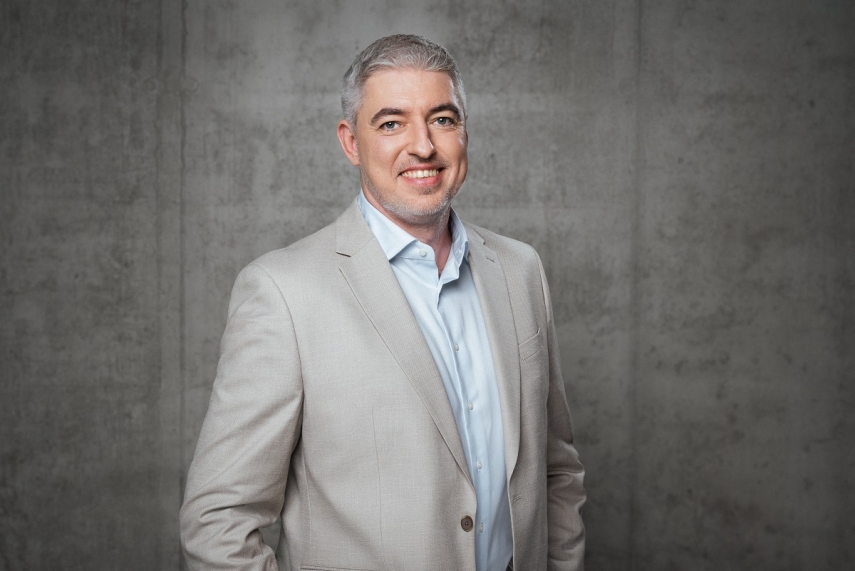
Photo: Tadas Goberis, Avia Solutions Group Board Member: ‘Life and business experience have shown that we are no worse – and in many cases more hardworking and more focused on meeting client expectations.’
Tadas Goberis, a member of the Avia Solutions Group Board and head of the Group’s aircraft leasing and acquisition company, shares insights from more than 15 years in aircraft management and leasing. Avia Solutions Group is the world’s largest provider of aircraft, crew, maintenance, and insurance (ACMI) services – operating in 68 countries.
You have been working in aircraft management and leasing for more than 15 years – practically the only Lithuanian with such experience. Recently, you were appointed to the Avia Solutions Group Board. How would you summarise these 15 years?
Professionally, they have been wonderful years. I came into aviation from the IT sector – two industries that are in many ways complete opposites: aviation is conservative and strictly regulated while IT is all about innovation. But I believe the industry matters less than the willingness to dive deep, focus on details, continuously learn, and communicate sincerely with clients and partners. Aviation gave me the opportunity to work with the entire world, with different cultures – that’s invaluable experience. The years flew by in an instant, which to me is a sign that they were not wasted.
What role does aircraft management play in the Avia Solutions Group business model?
Aircraft management is extremely important to a business model built around aircraft leasing together with crew, maintenance, and insurance (ACMI). Understanding the aircraft lifecycle, maintenance intervals and cost control, forecasting market changes, and responding in time are essential for successful operations. Although an aircraft’s lifecycle is relatively easy to predict – depending mainly on the calendar and flight hours – the crucial aspects lie in the fine details. Proper and efficient planning of engine maintenance alone can save millions. The Group has accumulated enough experience and expertise to make the right decisions in aircraft management, so we often consult our clients as well. Recently, the Group established a new company, Wolf Holding – a platform for aircraft investment that also provides aircraft management services to investors.
Over the past 10 years, more than 200 airlines have gone bankrupt, but not a single leasing company has. Why is that?
Of all players in the aviation industry, airlines have the toughest role – generating revenue by selling tickets and settling accounts with all service providers while hoping to profit. Airlines operate on the front line, facing the end consumer and payer. All other aviation market participants – whether aircraft maintenance centers, financiers, leasing companies, or pilot academies – do not deal directly with the passenger, yet quietly expect airlines to earn enough to pay them.
Leasing companies in particular are not inclined to take on any risks related to an airline’s operational success. When the airline is doing well and payments are made on time, everyone is happy. When the airline faces difficulties, leasing companies can overnight turn from business partners into the biggest threat, as they care only about timely payments under the lease agreements. Weaker, less experienced airlines often fall into the traps of lease agreements, which ultimately leads to bankruptcy. A few seemingly insignificant contract clauses can result in millions in additional costs during maintenance or when returning the aircraft to the lessor. Leasing companies bring a substantial amount of investor capital into aviation, and this is extremely important for financing such expensive assets as aircraft. But to be fair, I must say – especially among the largest leasing companies – there is often a tendency to squeeze the last drop from the lessee and, without hesitation, seize the aircraft and lease it to another airline.
Avia Solutions Group operates ACMI airlines from the United Kingdom to Australia. How many aircraft do you own, lease financially, or lease operationally?
I will answer somewhat unusually – I believe we own too few aircraft. That means we allow lessors to earn profit that could instead remain within the Group. Owning more aircraft would also let us solve problems ourselves when our airlines encounter them, rather than depend on external leasing companies and their goodwill. One of the drivers of aviation financing is aircraft trading, so the owner of an aircraft often changes annually or even more frequently. Our Group also actively participates in aircraft trading, so the number of owned aircraft is constantly changing.
Operational leasing is the most common type within the Group’s airlines – it provides certain advantages and, especially, flexibility at the end of the lease, when you simply return the aircraft instead of dealing with extending or finalizing its lifecycle.
What does aircraft supply and demand look like today? What role do Boeing and Airbus deliveries play?
The market is more unbalanced than ever due to disruptions in new aircraft production, which have persisted since the Covid pandemic, when the entire aviation manufacturing industry nearly came to a halt. The shortage of aircraft creates excess demand, which means that aircraft – especially used ones – are currently very expensive. The shortage is also driven by the fact that major airlines have not yet received their ordered new-generation aircraft in full, so they are flying older-generation aircraft longer than usual and not releasing them into the secondary market.
Both major manufacturers are still experiencing supply-chain problems. Boeing has come under scrutiny from civil aviation regulators due to quality issues, so production is limited to 38 aircraft per month – almost half of what it was during record years. Airbus currently produces around 45 aircraft per month, which is also far below previous volumes. New-generation engines have failed to meet reliability expectations and require maintenance much earlier than their predecessors. This also drives up prices for older-generation aircraft.
You lead the Avia Solutions Group aircraft ownership and management company. Is there synergy between your owned aircraft and the Group’s MRO company, FL Technics?
There is clear synergy, although that does not mean all Group-owned aircraft are serviced exclusively in FL Technics hangars. We do not seek – and do not want – to artificially distort market conditions. The Group’s airlines are treated just like any other customer. Ultimately, FL Technics competes with other MRO providers for the Group’s own airline maintenance contracts. One example of synergy is that in aircraft trading we can purchase more aircraft ahead of the summer season – when MRO demand is low – and prepare them during summer while keeping FL Technics hangars busy. Synergy is also evident when extra effort is needed to speed up work or respond to exceptional situations. FL Technics actively participates in aircraft acquisitions and sales by performing inspections and reviewing documentation.
How much does a 15-year-old Boeing 737-800 or Airbus A320-200 cost today?
The older the aircraft, the more of its value lies in the engines. Therefore, the price of a mid-life aircraft is determined primarily by engine condition and remaining life. Today, a 15-year-old Boeing 737-800 or Airbus A320-200 can cost between USD 15 and 25 million, of which the airframe itself is worth only USD 3–6 million.
Do you plan to purchase more aircraft in the future, or continue with operational leasing?
We plan to purchase more aircraft and keep them in our own ownership while leasing them to the Group’s airlines – thereby reducing the risk of disputes with leasing companies if the market suddenly turns negative. This way, the profit that would go to the lessor in an operational lease structure remains within the Group. Managing a larger owned fleet would also provide more opportunities for aircraft trading, which should further improve profitability. The key is finding suitable financing sources for aircraft acquisitions at an acceptable cost of capital.
What is the most interesting client or partner you have encountered so far in your career in aviation?
I would say it’s not so much the clients themselves as the interesting situations I’ve found myself in. I once had to fly out to retrieve an aircraft that a former lessee had simply abandoned on an island. I have also flown on empty aircraft with pilots and engineers during repositioning flights. I have met very diverse and unique clients – we even sold an aircraft to a little-known country like Nauru.
How much does Avia Solutions Group plan to invest in owned aircraft over the next five years?
Last year, Avia Solutions Group ordered 80 new Boeing aircraft. I can’t disclose the exact value, but it clearly exceeds USD 1 billion. I understand that this figure might be surprising, but in aviation you get used to the zeros – it becomes part of everyday business. For one billion dollars you get about 40–50 mid-life aircraft. Is that really a lot?
Although you are an Irish company, does Lithuania’s name resonate in the international aircraft leasing ecosystem?
Believe me, thousands of our clients and partners have learned about Lithuania through aviation. They gladly visit our Aero City campus during business trips. And we stopped being modest long ago; we once thought that foreigners might somehow be better than us in aviation. Life and business experience have shown that we are no worse – and in many cases more hardworking and more focused on meeting client expectations. We are proud that Lithuania is well known in the aviation world.

Please enter your username and password.

2026 © The Baltic Times /Cookies Policy Privacy Policy