Photo: Johan Widén from Pixabay
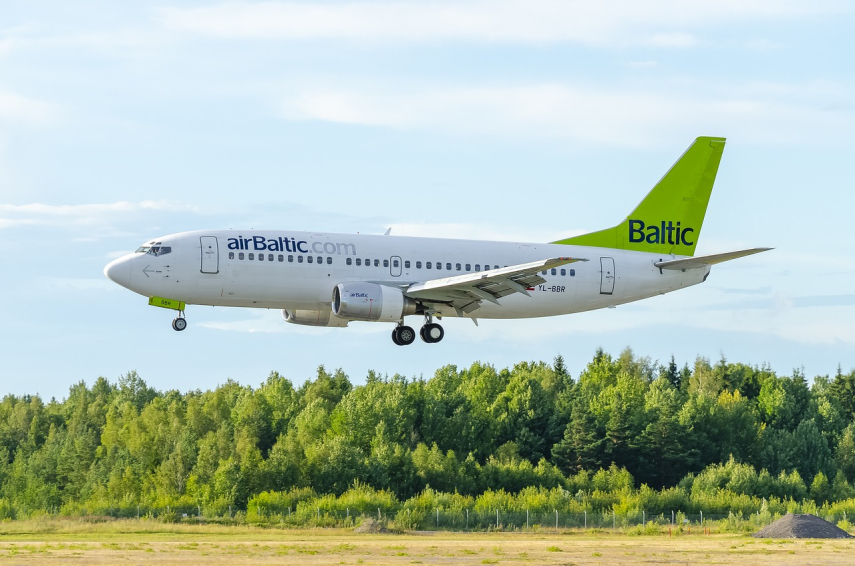
RIGA - Latvia's national airline airBaltic no longer emphasizes global growth in its business plan, Transport Minister Rihards Kozlovskis (New Unity) said in an interview LETA.
He promised to provide more detailed comments on airBaltic’s business plan at the end of the summer.
The minister acknowledged that it is difficult to strike a balance, as the plan is a trade secret, and any public statements or comments are evaluated by both investors and parties with whom the company has contractual relationships. "That is why I remain cautious. But, as I already mentioned, deadlines have been set, and they are in the fairly near future," he added.
When asked whether one of the options in the business plan is to scale back airBaltic’s operations, Kozlovskis said he did not wish to comment on the business plan but noted that the focus is not on global growth.
Kozlovskis said that the Ministry of Transport expects a well-founded expert analysis and assessment, without any preconceived notions about how things might turn out. According to him, it is important to understand in the business plan what the fleet looks like and when it generates the best revenue relative to its expenses. "That is the goal, because we are not talking right now about a clearly defined future government investment. This is a matter of attracting investment and investors," the minister emphasized.
When asked when and to what extent airBaltic will need government investment, Kozlovskis said that the Ministry of Transport expects the company to present a viable business plan so that, under certain conditions, the company can sustain itself. He emphasized that the business model can no longer be one where, when the company hits a dead end, there is once again a sum x that the government tries to invest in some way.
"That will not be the case anymore. I would rather not discuss specific amounts. A number of preconditions must be met. If there is a strategic investor who comes with real financing, real capital, and an offer to invest, then the question is whether the government will participate. There are a number of issues. But simply writing off EUR 150-200 million in losses and thinking everything will be fine - no, it is not that simple," the minister emphasized.
As reported, airBaltic Group's loss in the first quarter of this year amounted to EUR 70.064 million, which is 2.4 times more than in the first quarter of 2025. Meanwhile, airBaltic Group's revenue increased by 12.3 percent to EUR 149.086 million.
airBaltic's losses last year amounted to EUR 44.337 million, which is 2.7 times less than in 2024. Last year, airBaltic's turnover increased by 4.2 percent compared to 2024 and amounted to EUR 779.344 million.
In 2025, the airline carried a total of 5.2 million passengers on its route network, an increase of 1 percent compared to 2024.
At the end of August last year, German national airline Lufthansa became a shareholder in airBaltic. Currently, the Latvian state owns 88.37 percent of airBaltic shares, Lufthansa - 10 percent, financial investor Aircraft Leasing 1, owned by Danish businessman Lars Thuesen - 1.62 percent, and other shareholders - 0.01 percent. The company's share capital is EUR 41.819 million.
After the initial public offering (IPO) of airBaltic shares, the size of Lufthansa's stake will be determined by the potential IPO market price. The transaction also provides that Lufthansa will own at least 5 percent of airBaltic's capital after the potential IPO.
On August 30, 2024, the Latvian government agreed that the state should retain at least 25 percent plus one share in airBaltic's capital after the IPO. On August 19, 2025, the government decided that Latvia, like Germany's Lufthansa, would make a co-investment of EUR 14 million in airBaltic ahead of a potential IPO.
However, given the 2025 financial results and market conditions, airBaltic has suspended its planned IPO and does not currently view it as a potential source of capital for 2026, according to airBaltic’s annual report.
The report indicates that, despite the expected improvement in operational and commercial performance, the airline will operate with a negative free cash flow in 2026, and, based on current forecasts, management expects that an additional capital injection of EUR 100 to 150 million will be required to finance operations for the 2026/2027 winter season.

Please enter your username and password.


2026 © The Baltic Times /Cookies Policy Privacy Policy