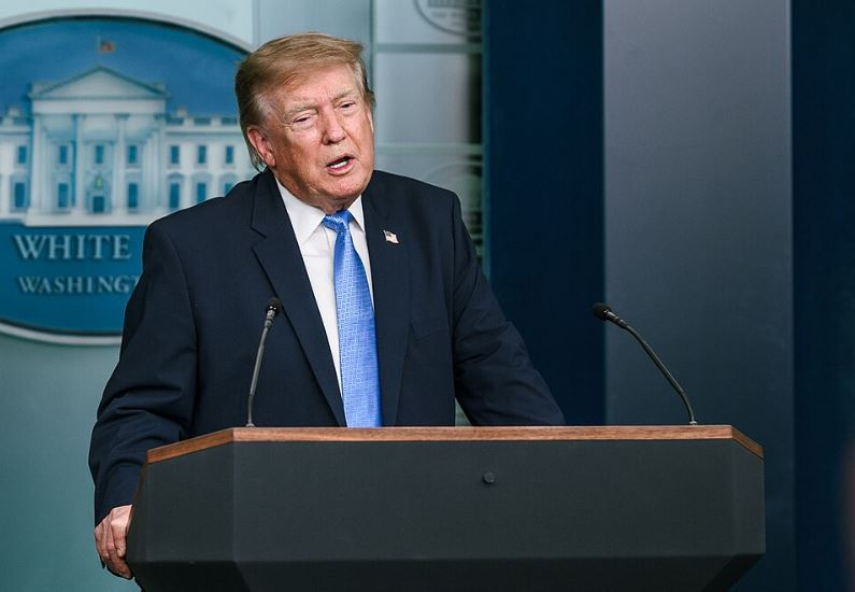
RIGA - If the Democrats were to gain control of both chambers of the U.S. Congress in the midterm elections, Congress could limit the power of U.S. President Donald Trump more actively, says Sandis Sraders, a board member of the Latvian Transatlantic Organization (LATO) and a researcher at the Latvian Institute of International Affairs (LIIA) and director of the Liepaja Academy of Riga Technical University.
Sraders told LETA that if the Democrats were to take control of the Senate and the House of Representatives, Trump might become even more aggressive and make decisions via presidential executive orders. In the expert’s view, such decisions would be short-term, as Congress controls the budget and both chambers have a major say in the U.S.’s long-term priorities in both domestic and foreign policy.
Sraders noted that it will be necessary to assess how the budget is drafted and whether Trump, through executive orders and funding allocations, will be able to achieve anything that would contradict Congress’s position.
The expert outlined two possible scenarios:Trump could either become even more unpredictable and erratic in his communication on domestic and foreign policy issues, or come to terms with his low approval ratings and become more subdued.
Sraders believes that Congress’ influence on domestic and foreign policy issues is growing. He noted that members of Trump’s team are gradually distancing themselves from the president’s decisions, attributing this to Trump’s low approval ratings. He concluded that Republicans, too, must consider their own future approval ratings.
Sraders expressed the possibility that Congress might finally begin to restrict Trump’s power and decisions, as has happened during the terms of other presidents. He added that, so far, Congress has remained silent and has not curtailed Trump’s actions; on the contrary - the Republican Party, which controls both chambers of Congress, has used legislation to strengthen the U.S. president’s influence.
Assessing the Republicans’ prospects in the midterm elections, Sraders stated that Trump’s actions to date have made it more difficult for the party to retain control of both chambers of Congress. He pointed to Trump’s promises to lower prices, revitalize the economy in the so-called Rust Belt states and regions, and keep the U.S. out of unnecessary wars.
In the researcher’s assessment, the promised price cuts have not materialized, and various products in the U.S. are becoming more expensive; furthermore, the promise to revitalize the economy in industrial regions has not achieved its goal. Sraders also voiced a critical view of the military action against Iran, which he described as strategically poorly planned. He linked this to the rise in diesel fuel prices, which is being felt by both consumers and various sectors of the economy and which, in his view, is eroding voter support for the Republicans.
In the researcher’s assessment, the war will have negative long-term consequences both for U.S. military resources and for the country’s ability to form coalitions and develop alliances to achieve peace and stability in the Middle East.
At the same time, Sraders acknowledged that the president does not have complete control over economic processes. These are also influenced by international markets and global developments that are beyond the White House’s control.
Speaking about relations with allies, the researcher emphasized that U.S. partners are assessing the risks associated with dependence on the United States. In his view, Trump has shown that the United States cannot be relied upon.
The U.S. midterm elections will take place on November 3. In these elections, all 435 voting members of the House of Representatives and 35 of the 100 senators will be elected.

Please enter your username and password.


2026 © The Baltic Times /Cookies Policy Privacy Policy