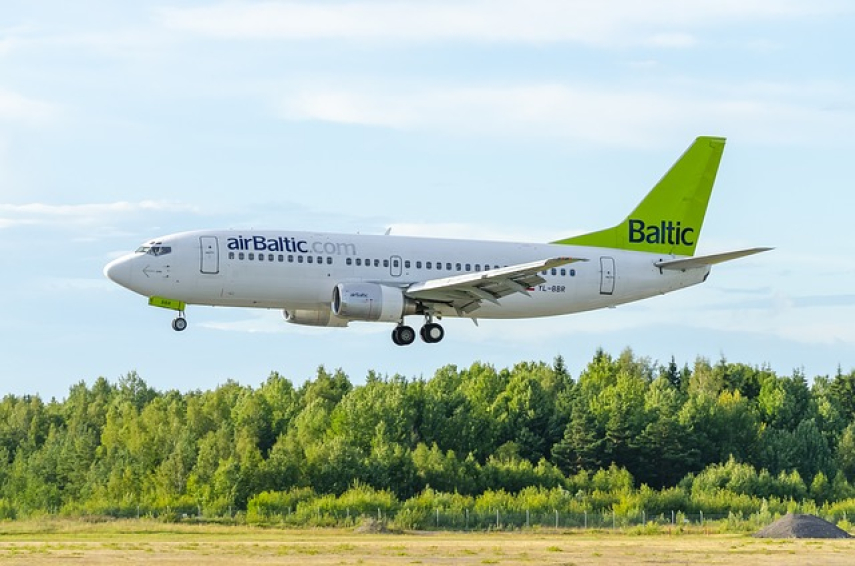
RIGA - The new business plan of national airline airBaltic, which envisages significant restructuring of airBaltic fleet and network, will directly affect employment guarantees for hundreds of employees, according to the Latvian Aviation Trade Union.
The union believes that during the work on the business plan, the company should have assessed various aspects of reducing the number of employees, as this is what would happen after a significant reduction in airBaltic fleet and operations, the Aviation Trade Union's President Dace Kavasa told LETA. Given such a significant impact, consultations with employee representatives should have been conducted, which did not happen, Kavasa notes.
The union says that in 2025, airBaltic's maximum number of aircraft was 54. According to the latest business plan of the airline, the number of aircraft will be reduced from 51 to 36 by the end of 2026. Furthermore, the long-term strategy calls for operating with only about 40 aircraft by 2031, which is a radical departure from the previously projected fleet of 100 aircraft.
Based on the Latvian Aviation Trade Union's calculations, which assessed the planned fleet reduction by approximately 30 percent and also considered other criteria related to the airline's operations, the union believes that scenarios involving a 20 percent to 30 percent reduction in the number of employees were also assessed during the development of the business plan.
In the union's assessment, even under the most optimistic scenario, the fleet reduction cannot be offset without a significant reduction in the number of employees. The union concludes that the company management's statements regarding the launch of an assessment of its impact only now are misleading, as such scenarios must have already been known during the planning process.
The Latvian Aviation Trade Union claims that airBaltic management has therefore failed to comply with regulatory requirements regarding timely notification and consultations prior to making decisions on its business plan that, by its very nature, has a significant impact on employees.
The Latvian Aviation Trade Union points out that no consultations with the union have taken place, and that the union was not provided with any information about the business plan at all - the union learned about it from the media.
Likewise, the Latvian Aviation Trade Union was not allowed to attend the August 11 online presentation of the business plan to airBaltic employees. The response to the union's request to join the online presentation was an invitation to meet on August 14. No other information regarding the business plan has been provided to the union at all.
The Latvian Aviation Trade Union points out that the obligation to consult is also stipulated by the European Union regulations, and the EU Court of Justice states in Case C-188/03 that the obligation to consult with employee representatives arises as soon as a strategic decision is made that requires the employer to anticipate or plan for termination of employment contracts or collective redundancies.
In the Latvian Aviation Trade Union's opinion, a business plan that already sets out specific, quantified targets for the airline's fleet and route network constitutes precisely such a strategic decision, and consultations with the union should have begun during the development of the plan, not during the plan's approval or implementation stage.
The Latvian Aviation Trade Union's is calling on airBaltic management and supervisory boards to commence discussions regarding the business plan's impact on the airline's employees, in accordance with the legal requirements to negotiate and consult with labor unions.
The Latvian Aviation Trade Union is currently the largest trade labor union in the aviation sector, representing employees from six aviation companies.

Please enter your username and password.


2026 © The Baltic Times /Cookies Policy Privacy Policy